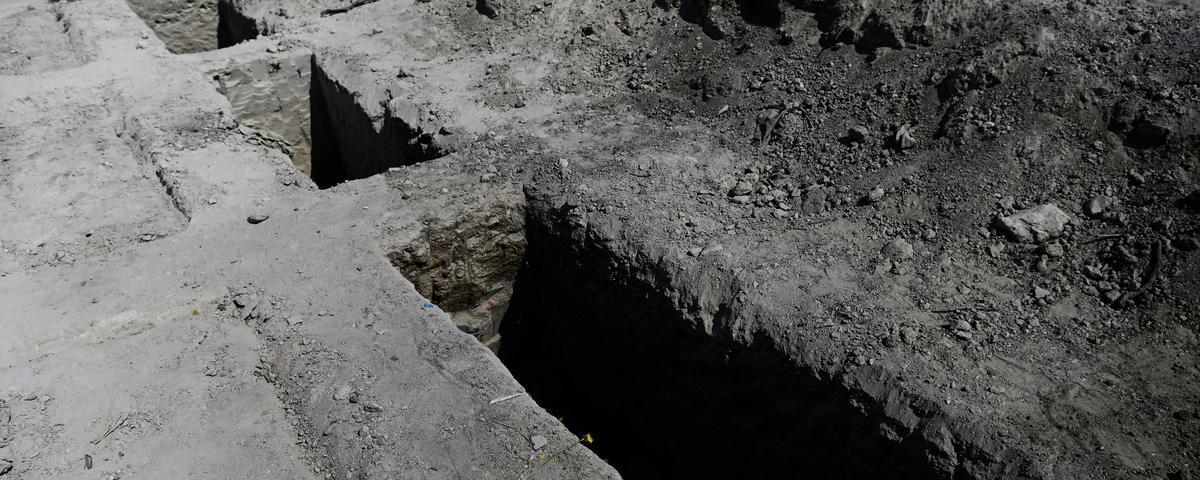
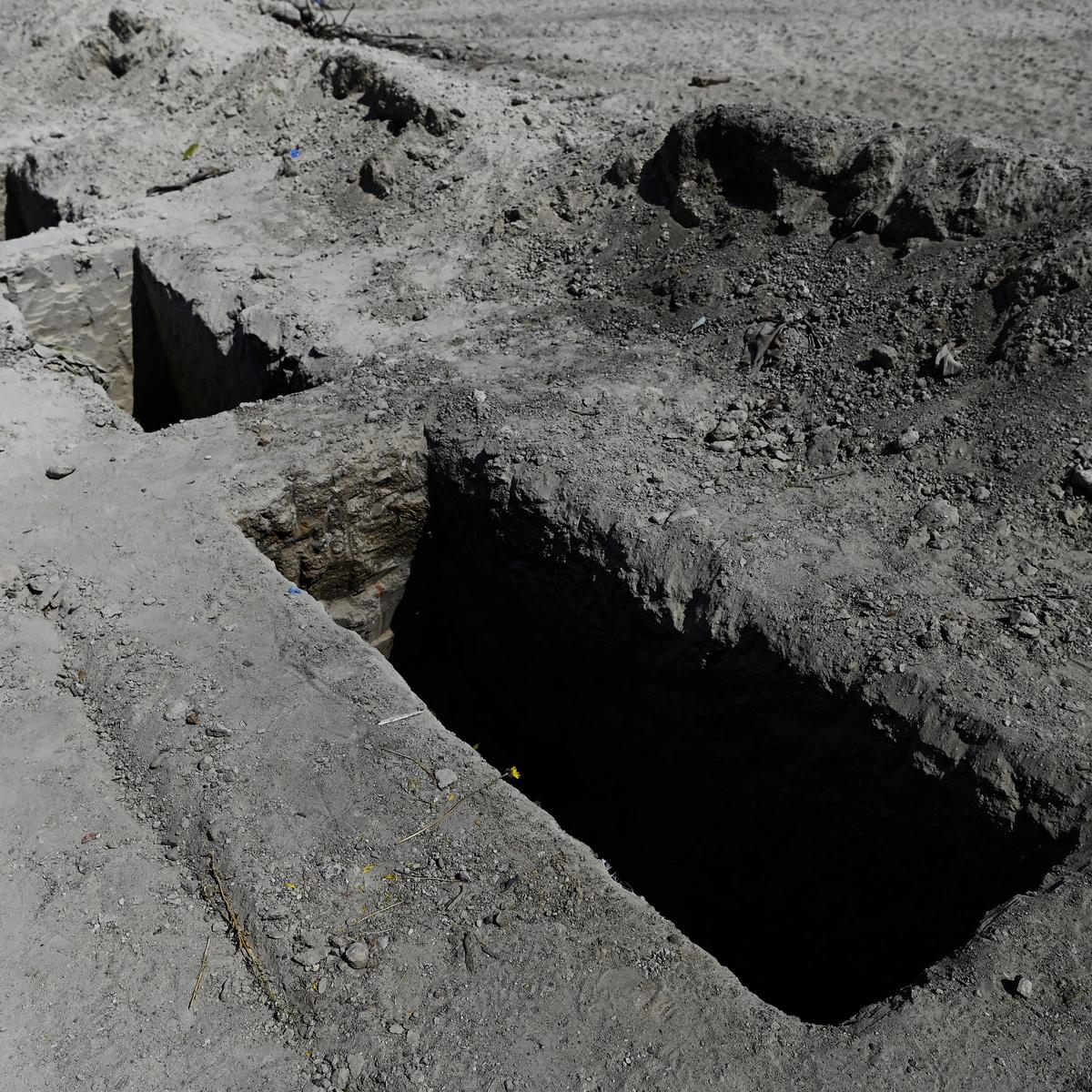
A man with an intellectual disability “disappeared” from the Mariona prison in June 2022. His older brother searched for him in hospitals and other prisons, but no one could provide any clues as to his whereabouts. Three months later, almost by chance, he found him in a mass grave at La Bermeja Cemetery in San Salvador. Six men, dressed in special white suits, opened the grave and pulled out a decomposed body: “I wasn’t repulsed. I recognized him by a scar on his arm; his face was disfigured. It was all swollen,” said his brother.
This is one of three exhumations investigated by El Faro under the state of exception, Nayib Bukele’s strategy that dismantled the gangs but has also violated the rights of hundreds of people who were arrested without evidence against them, who did not receive due process, and who died in state custody — with inconclusive autopsies and without the opportunity to defend themselves in court.
On June 1, 2026, Bukele will mark seven years in power, four of which he has governed under the suspension of constitutional guarantees. Month after month, for 50 months, loyalist lawmakers have extended the regime that put an end to the gangs, but also to the checks and balances of democracy. This has turned El Salvador into a country with political prisoners, with journalists and human rights defenders in exile, and with prisons turned into torture centers.
From the Bowels of Bukele’s Prisons: Survivors Recount Death, Torture, and Starvation
The government has classified as confidential all information regarding deaths in prisons, but organizations such as Socorro Jurídico Humanitario report 526 deaths from the start of the regime on March 27, 2022, through May 15, 2026. Reports submitted to international bodies such as the United Nations and the Inter-American Commission on Human Rights detail torture, abuse, forced disappearances, and violent deaths. The latest report from the International Federation for Human Rights indicates that the state may have committed crimes against humanity.
El Faro has investigated 18 of the 526 deaths reported by Socorro Jurídico Humanitario. These cases include the death from severe malnutrition of Juan Saúl Castillo or the arbitrary arrest of Blanca Osmilda Castro Quijada, a 60-year-old woman who lived in a neighborhood free of gangs and who died in the Apanteos prison.
In this investigation, the newspaper reconstructs the story of three detainees held by the regime who died in state custody and were buried in mass graves. All showed signs of a violent death, a fact ignored in the forensic reports. All were legally innocent because they had not been convicted in court. The state buried the bodies without informing their families. Families continued to bring packages containing basic supplies to the prisons where they believed their relatives were being held, and the prison system accepted them without hesitation. The state received packages intended for the dead.
The state of exception prohibits family visits and communication between detainees and their lawyers. Furthermore, the prison system accepts the packages but provides no assurance to family members that their relatives received them. The only way for family members to enter a prison to see their detained relatives for a few minutes, or to communicate with them through letters, is by paying between $200 and $500 to a prison corruption network. Inmates who have money pay up to $35,000 to be released from prison and admitted to a private hospital, so they can meet with their lawyers and family.
On the morning of May 25, 2026, El Faro requested an interview with the Office of the Human Rights Ombudsman, the Bureau of Prisons, and the National Civil Police. The request was made via institutional emails and official social media accounts. As has been customary since Bukele took office in 2019, they did not respond.
This newspaper interviewed relatives of the deceased and obtained some twenty official documents. The police files, court records, statistics, and intelligence reports were obtained through a leak of thousands of gigabytes of official documents by DDoSecrets, an organization dedicated to releasing information of public interest. These are the stories of those who died without a trial and without a funeral.
Marvin: the bricklayer who never met his son
During the first week of April 2022, a rumor spread through the scattered homes nestled among pine forests and hills in villages such as El Gramal, Los Horcones, El Terrero, El Guayabito, and Rancho Quemado, in La Palma, Chalatenango.
“They say they’re dragging people out of their homes,” his wife said. But Marvin Antonio Benítez Perlera, a 22-year-old mason’s assistant, remained unperturbed. “I’m not going to run away; I haven’t done anything wrong.”
A few days after that conversation, a police officer and three soldiers walked down one of the dusty alleys of Rancho Quemado, reached an adobe house, and arrested Marvin for membership in an illegal group on April 6, 2022, just one week after the state of exception was declared. Marvin never returned home or to his job: He died on June 26, 2022, two months after his incarceration at the La Esperanza prison, known as Mariona. His body lay for a month in the Institute of Legal Medicine’s morgue and was then buried in a mass grave at La Bermeja Cemetery, as if nobody had claimed his body.



Marvin’s partner was pregnant at the time of his capture and says that due to their poverty, she went hungry to be able to bring care packages to her detained partner. The packages contain basic supplies, such as toothpaste, antifungal creams, sugar, milk, coffee, and cookies, and cost between $60 and $125. Some families buy the packages outside the prisons; others prepare them at home with groceries from the supermarket and hand them over to the guards without any certainty that their relatives will receive them.
What she didn’t know was that she was bringing packages to a dead man. She brought packages in June, July, August, September, and October. She delivered the last package in November 2022, when Marvin disappeared from Mariona’s list.
“Those packages hurt me. I’d clench my stomach to take the package to him, because they told me he was there. I’d put together the package with things I bought for the house or include things people gave me. People would tell me: take some milk, take this [toilet] paper,” says Marvin’s partner.
***
The department of Chalatenango reported few arrests until before the state of exception. On Sunday, March 26, 2022, for example, only one arrest was recorded. The next day, following the breakdown of secret negotiations between the Bukele administration and the three main Salvadoran gangs, the police machinery was set in motion, and on Monday they arrested 19 people; on Tuesday, 9; on Wednesday, 26.
From that very first moment, comments began to surface on social media and complaints in the press from people claiming that their arrested relatives had nothing to do with any gang. Over time, that information would be validated by journalistic reports and reports from civil society organizations. The police had understood that Bukele wanted to send a message of strength and that that message would be conveyed through images of thousands of arrests. They understood that the images had to be delivered quickly and made arrests at their discretion.
The Chalatenango raids were dubbed the “Clica Strategy,” according to police documents in El Faro’s possession. The operations were intended to dismantle eight Mara Salvatrucha-13 groups operating in that department: the Arcatao Locos, the Sierpeños Locos, the Criminal Cruces, the Lagunas Locos, the Angosturas Locos, the Sombra del Parque, the Granja Locos, the Hollywood Locos, and, above all, the Fulton Locos Salvatruchos (FLS), the faction with the most control in Chalatenango.

The wave of arrests reached the rural area of La Palma on April 6, 2022, after 5:00 p.m. Of the 17 people arrested in Chalatenango that day, 11 lived in hamlets located along the dirt road leading to the Los Horcones district. The other six resided in neighboring municipalities, such as La Laguna, Agua Caliente, and the Reubicación II neighborhood.
A campesina from Rancho Quemado recalls her neighbors’ desperation at the time of the raid: “On the other side of this hillside, you could hear the woman’s desperate screams.” The screams were those of an elderly woman named Rosa Amelia, mother of Francisco Evelio Portillo Pereira, 37, Marvin’s uncle. The police arrested him based on a record that profiled him as a “collaborator” with the Fulton Locos Salvatruchos — a weak piece of evidence, because six months later the Specialized Court C-3 in San Salvador granted him conditional release, according to official documents.
When Francisco Evelio returned home, he found his mother very ill. “When they took him away, she got really sick. Since she was quite old, she couldn’t handle the depression. Her son got out and managed to see her, but she died,” says the woman from Rancho Quemado who spoke with El Faro on the condition that her identity be protected for fear of reprisals. “Some have already been released, but many remain in detention. It’s not that we owe them anything, but it’s scary that they might come back and take a family member or someone we know.”
After capturing Francisco Evelio, the police and soldiers walked down a dusty street and entered an adobe house under the false pretense that they had received a report of domestic violence against Marvin. That altercation never happened, according to the accused man’s partner. Once inside the house, they arrested him for being a “homeboy” and for “selling drugs” for the Fulton Locos Salvatruchos. The evidence: a police record and a criminal history for the seizure of a “small handful of monte” (marijuana) in 2020.
“He smoked — why would I lie to you? They caught him once for a small handful of weed he’d bought. So, he was jailed in Chalatenango for three days; then we got him out with a lawyer. He had a criminal record because he’d been in jail for three days,” says Hugo Amílcar Benítez, Marvin’s father.
He is surprised by the police record linking his son Marvin and his brother-in-law Francisco Evelio to the Fulton Locos Salvatruchos gang. “No, he wasn’t a gang member, and neither was Chico. Neither had tattoos, nor any gang-related markings. Who knows why the police put that in.”
Amendments to the Law Against Organized Crime allow police reports prepared by officers to be considered evidence, even if this information has not undergone an investigation or verification process. This has enabled a series of abuses bordering on fabrication. In Sonsonate, for example, the police turned a Salvadoran rapper with U.S. citizenship into a gang member overnight; in Chalatenango, officers created a false police record to arrest a lawyer who now has asylum in a European country due to those irregularities in the police investigation.
The father denies Marvin’s ties to gangs and says the arrest “may be” the result of the prior case involving the seizure of marijuana intended for personal use, even though that matter was settled in court.
Marvin was sentenced to community service: for a year, he swept the streets of La Palma. “They had given him a document stating that he was performing community service at city hall. He completed all of that. He said that people here who saw him would make fun of him. ‘If they take me [to prison], they’ll take me for what I was already imprisoned for; they’ll just let me go again — they’ll take me all the way back to La Palma. Why should I run? I owe nothing,” Marvin told his partner days before his death.
***
Marvin worked as a mason’s assistant at Quinta Los Pinares in La Palma. He earned $15 a day and showed such talent at his job that his boss offered him a position as a mason, provided he had his own tools. So, he began to save: He bought a box level, a tape measure, a finishing trowel, masonry string, and a square.

The alleged drug dealing for which he was arrested did not fit his routine or his financial profile. He would leave on his motorcycle for work at seven in the morning and return at three in the afternoon. On weekends, when he received his pay, he would ask his wife for a shopping list, and during his free time he made adobe bricks so the family could stop living in a makeshift shack. “It was quite a struggle. We made 25 adobe bricks a day, sometimes 50, depending on how much money we were making. We used over a thousand adobe bricks for the house, and some relatives helped me with the roof,” says his partner.
Three months before his arrest, in January 2022, Marvin found out he was going to be a dad for the first time. His partner recalls that he accompanied her to her prenatal appointments: “When I got pregnant, he was over the moon because he was going to be a dad. ‘I can’t believe it, I’m going to be a dad!’ he’d say.”
A Salvadoran law called “Nacer con Cariño” (Born with Love) mandates that women receive respectful childbirth care and that newborns receive loving care. This law was proposed by First Lady Gabriela Rodríguez de Bukele and approved by the Bukele-controlled Legislative Assembly on August 17, 2021, yet officials in charge of the regime often fail to comply with it.
In July 2023, El Faro reported that 30 babies contracted scabies at the Izalco Penitentiary Farm, and the prison system failed to provide them with medical care, which is why their mothers bathed the children with detergent and bleach. In January 2026, two children whose parents were arrested by the regime were admitted to the Psychiatric Hospital surrounded by adults, violating another initiative of the ruling party: the Growing Together Act.
Marvin’s son also did not benefit from the Born with Love Act. On April 6, 2022, when his father was captured, the mother nearly suffered a miscarriage. She says it was due to the distress of the capture and of going to the police to ask about the detainee’s whereabouts, with no one providing her any information. A lump formed near where the fetus was: “A big lump formed here [stomach]; when I went to look for him in Chalate, a big lump also formed. By the grace of God, the child is fine.”
After the difficult days of the arrest, the long months of carrying the baby to term began. During that time, she went hungry. The child was born via C-section in late 2022.
The wife learned of Marvin’s death from her father-in-law in November 2022. But she suffered the emotional impact in February of the following year, when the body was exhumed. In the ensuing months, the barely two-month-old child could not be with his mother — another right supposedly guaranteed by the new child protection laws. She had fallen into depression. “That night they gave me the news, I felt like I was going crazy. For three months, they wouldn’t let me leave the house; I was just locked up, crying all the time. My mom took care of the baby.”
Marvin’s son is now a boy with fair skin, big black eyes, and straight black hair. He lives in the adobe house his father built for him; he has some plastic toy cars and little chicks he plays with in the dirt yard. Marvin never met his son. From time to time, they show the boy a photo of his father and tell him he’s in heaven.
“When he gets older and asks me questions, I’ll have to think about it. I don’t know if I’ll have answers to everything he asks me,” says his mother.
***
Acute lymphocytic leukemia is a cancer of the blood or bone marrow that occurs when the body produces an excess of white blood cells. According to Legal Medicine, this was the cause of Marvin’s death on June 26, 2022.
Although they were unable to examine the body, as it was buried in a mass grave in July 2022, the family has evidence that Marvin was the victim of a violent death based on the photographs shown to them at the morgue — a fact omitted from the coroner’s report.
“I went to the Institute for Legal Medicine [in November 2022] and they gave me a book there. I started flipping through it and that’s where I found it. He had some scratches on his neck, as if they had tried to strangle him in prison, because it was really bruised,” says his father.
The court assigned to Marvin’s case did not order an investigation into his death, and the documents indicate that they were not even aware of his burial in a mass grave, because they continued to prosecute him for membership in an illegal organization. On January 18, 2023, the Specialized Investigative Court C3 extended the investigation period against Marvin and 93 other detainees for another year. In other words, the court ordered proceedings against a dead man.
Our Bottomless Well
The judges presiding over the Courts Against Organized Crime, created to implement the regime’s reforms, are judicial officials imposed by the dictatorship, many of whom have backgrounds as prosecutors. The Supreme Court of Justice, with justices imposed by Bukele’s party since May 2021, punishes judges who do not follow guidelines, or rule against the interests of the ruling party, by transferring them to the interior of the country or to lower-ranking courts.
Hugo Amílcar tried to document his son’s death and demand an investigation. He soon encountered obstacles even in routine procedures. For example, the San Salvador Mayor’s Office refused to give him the death certificate and told him he had to hire a lawyer for that process. He gave up.
“I didn’t pursue anything; I didn’t go through with the process because I was short on funds. I traveled there [to San Salvador] for three months to get the boy out of the cemetery, and then I was left penniless. Since you don’t know your way around, you have to pay for taxis; there were times I had to go to the Prosecutor’s Office, to Santa Tecla, to Santa Elena, to the Ministry of Health. I spent at least $50, $60 on fare for each trip, on food and everything. As a poor man, well, I can’t afford to be running around so much,” he says.
Marvin’s family wants to demand justice, but they can’t.
Rafael: victim of MS-13 looting
Rafael López Castellón, 53, owned a mill and a store. The store, with walls made of rusted metal sheets, had two refrigerators stocked with sodas, beers, juices, chicken wings, sausages, cheese, and cream — products he sold to earn a few dollars and buy his medicine for kidney failure and seizures caused by heart problems. Rafael lent money to the Padecom Crédito cooperative and invested, but his plan to make money, survive, and buy medicine was often interrupted by looting by the Mara Salvatrucha-13. Gang members, sometimes armed with AK-47s and M16s, would show up and take almost everything. The little store was like an open pantry to them.
“They [the gang members] were always coming to ask him for things. They didn’t empty the store every time, but when there were several of them, they’d just walk in and tell him to eat whatever they wanted. And there were times when they took everything,” says Pedro Ascensión López Castellón, one of Rafael’s brothers. The business started with loans between $1,500 and $2,000, but when the looting occurred, he would ask for refinancing: sometimes $200, sometimes $350. He would buy more chicken wings, more soda, in the hope that the gang members wouldn’t return. Or, at least, wouldn’t return soon.

Rafael had the tasks of Sisyphus: He borrowed to invest, and they robbed him. He refinanced the loan, and they looted him. This vicious cycle ended when the gang members were captured under the state of exception. To the family’s surprise, the regime also captured Rafael. He had survived 23 years with kidney failure but died in state custody 54 days after his capture. His body was buried in a mass grave at La Bermeja Cemetery. His family continued to bring packages to the prison, believing he was alive.
***
The López family’s land lies between the main street of the canton Loma de la Cruz and a dirt road leading to a farm known as Los Vigiles, in Jucuapa, Usulután. There are three houses: one is made of adobe, with a tile roof and a dirt floor, where Manuel de Jesús, the patriarch of the López family, lives and will turn 100 this month. The other two are shacks made of wattle-and-daub and corrugated metal sheets. A fence, made of aluminum posts and wire mesh, separates the dirt road from the shack where Rafael had his mill and store. That fence bears evidence of gang violence against the family.
“One night they came with two AK-47s and an M16. The bullet holes are right here on this post, and they went right through these pipes. It’s no lie,” says a second relative of Rafael who spoke with El Faro on the condition that his name not be published. “That house also has other bullet holes from crossfire. They came high, stoned. The one who fired these shots was named Andrés, but here they knew him as Chino or Colombo.”

Death threats, extortion, and robberies by the gangs were routine. Rafael endured that spiral of violence and advised his brothers to not put up a fight. “They [the gang members] would sometimes wait until late at night to come and loot all his food and drink. The guys came hungry, and they wouldn’t give them a penny. Then, one of my brothers told them they had already paid for what they were eating, and Rafael didn’t say a word — he just kept his head down. Later, Rafael told my brother not to go around saying things like that because he did that —he didn’t say a thing, even if they ate everything— just to save his life. He used to say: If I run out of money and lose the store, I’ll take out another loan. And I’ll make it back that way by working, but you can’t get your life back.”
In the words of Pedro Ascención, his brother “knew how to live life.”
Some of the gang members who looted Rafael’s store are now dead, and others are imprisoned by the regime. Far from feeling relief at the absence of their tormentors, the López family has lived in anguish since the afternoon of April 8, 2022, when Rafael was captured and charged with ties to terrorist organizations. According to police records, that sick man, a victim of MS-13, was a threat to state security.
El Faro obtained several documents from the official investigations. According to a police report, Rafael was arrested for “being an active member of the MS-13 JLS clique (Jucuapenses Locos Salvatruchos).” The official account states that at the time of his arrest, he was meeting with two gang members: Marvin Alexander Herrera, alias Chango, 18, and Jorge Luis Medrano Blanco, alias El Tumbao, 39.
“We were conducting a preventive patrol within the city of Jucuapa when we were informed that a group of gang members, including an individual known as Pingüino and Chango, were gathered at Mr. Rafael López’s mill, located in the Loma de la Cruz district. We immediately proceeded to the aforementioned location, where we indeed found the now-detained individuals gathered. According to public reports, they are active members of the MS gang and meet at that mill every day to drink alcohol and use drugs, and the mill’s owner hides firearms for them and provides them with lodging there so they can plan criminal acts,” claims a police report prepared by Sergeant Luciano Hernández.
The police report omits an important detail: Marvin Alexander Herrera came to the mill every day because he was employed by Rafael; he drove a motorcycle for him and helped with purchases for the store. “My brother couldn’t get around on his own because of his illnesses; he couldn’t carry much. He had a motorcycle to haul his goods; that day they brought a new tire and were putting it on there,” recalls Pedro Ascención.
The third person mentioned in the police report did not live in the Loma de la Cruz district, but at an inn in Jucuapa. This is Jorge Luis Medrano Blanco, alias El Tumbao, a gang member who was deported from Panama to El Salvador in October 2016. Police documents describe him as having several tattoos: an MS-13 on his chest, the name Antonela on his right arm, the name Martha on his left forearm, and El Salvador on his neck. Family members say that the meeting between Rafael, Marvin, and El Tumbao described in the police report never took place.
“No, we don’t know that first or last name! We’ve never met that guy or heard him mentioned. That nickname, El Tumbao, either — that’s way off,” responded Pedro Ascención. Rafael’s second relative, interviewed at a different time and place, says he also knows nothing about El Tumbao: “That story about him meeting with Mr. Medrano Blanco is a lie. I’ve never met anyone with that name.”
According to the report, the “voz pública” or “public opinion” said that Rafael was a gang member and that he was meeting with Chango and Pingüino, but the same document states at the end that he was meeting with Chango and El Tumbao. What the police report describes differs from what the relatives saw on the day of the arrest.
There are also contradictions between that report and the information in the police’s Imperium System. While the report states that Rafael was an active member of an MS-13 clique, he appears as a “collaborator” in the Imperium registry.
According to the Imperium System, Rafael was captured on allegations of belonging to a terrorist organization, but prosecutors charged him with participation in illicit groups in the Specialized Court C2 of San Miguel on April 22, 2022. This made the legal mess even more complex. Rafael and 145 other people who lived in areas far from their district (Jiquilisco, Concepción Batres, Ereguayquín, Tecapán, Santa Elena, Nueva Granada, San Francisco Javier, Santa María, California, Puerto El Triunfo, Berlín, San Agustín, Mercedes Umaña, San Dionisio, and Estanzuelas) were charged with being part of a criminal organization.
According to court filings, the only evidence the five prosecutors presented to prove Rafael’s membership in MS-13 was the police report stating that “public opinion” had indicated he was a gang member and that weapons were stored and crimes planned at his mill. That same report details that when the mill and the store were searched, nothing illegal was found.
Justifying arrests based on “public opinion” was a method frequently used by police at the Jucuapa station. On April 5, 2022, officers patrolling the Llanos de San José neighborhood received a tip from “the public” about armed individuals and arrested Emmanuel Ibarra.
Four days later, on April 9, a group led by Sergeant Luciano Hernández, the same officer who arrested Rafael, received information from “the public” about an individual with the appearance of a gang member in the La Gloria neighborhood and arrested Jesús Ramírez. The following day, April 10, Melvin Martínez and José Campos were arrested because they were gang members, citing the same evidence.
The labeling of Rafael as an active member of MS-13 seems absurd to the López family. “Chepito (Rafael) once told me: when these guys [gang members] come, don’t get involved because they’ve already sentenced me — they’re going to leave me lying in the yard,” says his relative. The violence suffered by the López family paints a different picture from the gang collusion mentioned in police documents. “Don’t you see that it makes no sense for them to come and accuse him of belonging to an illegal group?” asks the campesino.
***
On August 8, 2022, Pedro Ascención went to the San Miguel Correctional Facilities office to request his brother’s records. He paid $3.50 for the document to begin gathering as many official papers as possible to prove the detainee’s innocence. That hope lasted almost no time at all. That day, they called him into an office to break the bad news.
“We won’t be able to give you the document you want,” they told Pedro Ascención. “Your relative is listed as deceased here, and since he is deceased, we cannot provide this to you.” The prison employee apologized for not even being able to provide his criminal record.
Pedro Ascención tried to verify the death with the Office of the Human Rights Ombudsman, but they told him to call the next day. The next day, he contacted one of his friends who works at a funeral home and has contacts at Legal Medicine. The friend was able to confirm that Rafael died on June 1, 2022, although one of his last names had been changed: Castellón to Castillo.
The family obtained more details on August 9, 2022, when they arrived at Legal Medicine to identify Rafael through photographs. There they were told that he had been transferred from Mariona prison to Zacamil Hospital on May 27, 2022, and that four days later he died of cardiomyopathy, a disease of the heart muscle that makes it difficult for the heart to pump blood to the body. The body remained in the morgue for 20 days and was then buried in a mass grave at La Bermeja Cemetery in San Salvador.
A Legal Medicine employee told them that the exhumation process was bureaucratic, that perhaps it would be best to leave the body in the mass grave and bring flowers there on All Souls’ Day. “He’s here like a stray dog. We’re not going to leave him like an animal; we’re going to do everything possible to take him, to have him close to us,” Pedro Ascención replied.

The López family are day laborers who work on farms, and their occasional earnings range from $20 to $30 or $50 a day. The paperwork for Rafael’s exhumation and belated funeral worsened their already dire financial situation. Pedro Ascención estimates he spent about $2,700: “I went to San Salvador four times and spent $90 per trip; the Ministry of Health’s permit for the exhumation cost $75; they asked me for a coffin that came as a two-in-one set. It was like a cooler. One cost $350 and the other $300. I had to pay for the cemetery permits. I lost track of how much we spent.”
In addition to the exhumation costs, the family lost another $250 on two packages they sent to the Mariona prison. One was delivered on May 31, 2022, one day before Rafael’s death. Pedro Ascención asked the guards about his brother’s health, and they replied that he was fine, locked in a cell in sector two. That was a lie because Rafael had been hospitalized at Rosales Hospital for three days, and he died the next day at 6:30 p.m. The second package was delivered in July 2023, when Rafael had been buried in the mass grave for a month. The prison system accepted the package without any qualms, saying nothing about the detainee’s death.
The family has testimonial evidence that Rafael was the victim of a violent death, but no authority has investigated it. “I have information from some friends who have been released from prison, and they tell me they saw him there [in Mariona], isolated and beaten up,” says his brother. Two years later, Rafael’s death remains unpunished.
Henry: a disabled man with a bruised face
Henry Eleazar Joya Jovel was six years old when he suffered a blow to the head. It was 1983, and from then on he had trouble controlling his laughter due to brain damage and epilepsy. “He was hit by a car while he was with my mother selling fruit, water, and soda. He wasn’t the same anymore; he was left with mental trauma. He would talk to people and everything, but he would always laugh. It wasn’t normal; something in his mind wasn’t right,” says Jesús Alberto, his older brother.
Henry never had a formal job due to his intellectual disability. At first, he helped his mother with street vending, and when she passed away, his brother took on the responsibility of renting him a room in the Luz neighborhood of San Salvador, where he earned $5 or $6 a day by helping his neighbors take out the trash or prune trees. On Sunday, April 19, 2022, at 9:30 p.m., six police officers arrested him for unlawful assembly. That same night, two other residents of the Luz neighborhood were detained for the same offense.
The neighbors called Jesús Alberto to tell him about the arrest, and he arrived quickly to tell the officers that his brother was disabled. “They didn’t give me any information or anything; they just told me, ‘We’re taking him.’ ‘But why?’ I asked them. At that time, the crackdown was just beginning; the police were rounding people up like when you played tag as a kid: catch a thousand, catch anyone. When they grabbed him, they just said, ‘You’re coming with us,’ put the handcuffs on him, and took him away,” his brother recounts.
The police took Henry to El Penalito, a police station near the La Tiendona market where detainees were initially held before being sent to a prison. Henry stayed there until April 21, 2022. He was then transferred to Mariona. The next day, April 22, Jesús Alberto went to the prison to warn them that his brother had a disability and needed to take medication daily. No one listened to him. “We gave them the information and told them: look, he has this and that condition in his head, he takes medication. Maybe it was a crime to bring medicine, because they didn’t let any of that in, neither at El Penalito nor at Mariona,” says his brother.
Henry died on May 25, 2022, after 36 days in state custody. The autopsy report from the Institute of Legal Medicine established that the cause of death was pulmonary edema; specifically, acute pulmonary pneumonia.
Acute pulmonary pneumonia consists of inflammation that fills the alveoli (air sacs in the lungs) with fluid or pus. There are two possible ways to contract this infection: the first, through infection by viruses, fungi, or bacteria; and the second, through a severe blow to the chest that causes blood or fluid to accumulate in the lung tissue.
The forensic report states that Henry “apparently” had acute pulmonary pneumonia since his capture, because the medical examination conducted that day described “a collapsed lung.” For the Joya Jovel family, that conclusion makes no sense: “My brother didn’t have any lung problems, or back pain, or anything like that. It’s all very strange; every cadaver from the prison shows up with pulmonary edema.”
“Pulmonary edema” are the two words that the Forensic Medicine Institute uses to conceal violent deaths in prisons. A clinical euphemism to avoid documenting lacerations, signs of strangulation, and puncture wounds on dozens of bodies. In the first six months of the regime, and according to the regime’s forensic pathologists, pulmonary edema was the cause of death for 36 of the 69 deceased detainees.
Among these cases was that of Francisco Huezo López, a merchant from Chalatenango known as Don Paco, whose body had a blow to the head, bruises on the right cheekbone, arms, and feet, but who, according to the forensic report, died of pulmonary edema. In many of these autopsies, the forensic pathologists leave a note: “cause of death under investigation.”
Due to his intellectual disability, epilepsy, or the “pulmonary collapse” described in the medical examination on the day of his arrest, Henry should not have been imprisoned in Mariona. At least, that is what the Fourth Court Against Organized Crime in San Salvador concluded. “The Prosecutor’s Office did not present the forensic assessment of his health status at the hearing to impose precautionary measures, in order to resolve the matter accordingly, in keeping with the right to health,” reads a ruling dated February 14, 2024, two years after Henry’s death.
***
Jesús Alberto continuously cared for his brother, especially after the accident that left him disabled. He felt responsible for Henry as if he were his father. He spent part of his salary as a janitor at a company to buy him two packages a month, hoping that his brother would have the essentials in Mariona.
In May 2022, the month Henry died at Rosales Hospital, Jesús Alberto brought two packages that cost him $140. In the following two months, June and July, while the body was in the morgue, he spent another $280 on four more packages that the guards received, as in previous instances, without any qualms. “They only asked me for my name and my brother’s. They accepted the package, but they didn’t give me any information about him. When I asked more and more, they told me: ‘He’s not on the list,’” his brother recounts.
Henry disappeared from the list of inmates at Mariona at the end of July 2022.
According to documents from the exhumation proceedings of the Third Court of Peace, Henry was buried in mass grave 319, level two, at La Bermeja Cemetery, at nine o’clock in the morning on July 8, 2022. The documents do not specify how, or at what point, a state institution changed his last names: Henry Eleazar Joya Jovel was buried as Henry Cuéllar Jovel, which made it difficult for his family to find him.
During those days, Henry’s brother sought help from the Bureau of Prisons, the Solicitor General’s Office, the Court, and the Attorney General’s Office, but to no avail. He then visited the Rosales and Zacamil Hospitals and the prisons in San Vicente, Apanteos, and Quezaltepeque, but found no information on his brother’s whereabouts. On September 7, 2022, he filed a report with the Office of the Human Rights Ombudsman regarding his brother’s “disappearance,” though that too proved futile.
Between August and the first half of September 2022, Jesús Alberto was contacted by two people who had been detained at Mariona. One of them told him about the beatings Henry had received in prison. “He called me on the phone and gave me that information, but he didn’t want to meet with me. He told me: ‘They didn’t give us food; what we went through was incredibly hard.’ His brother couldn’t take all the beatings. They kind of messed up his stomach from all the kicks they gave him. He went to the hospital, and after that I didn’t see him anymore — he never came back,” Jesús Alberto recalls that the person told him.
On the recommendation of those two people who called him, on September 19, 2022, Jesús Alberto went to the Institute for Legal Medicine to ask if his brother was in the morgue. They showed him a photo album of the deceased, and there he recognized Henry, whose last name had been changed: instead of Joya, they had written Cuéllar. The photographs confirmed the previous information about the beatings his brother had suffered. “When they showed me the photographs at the Legal Medicine Institute, he had some bruises on his face, and another bruise around his eyes. Those were the blows he had received.”
The autopsy report lists the cause of death as acute pulmonary pneumonia, but the report also mentions that the body had “contusive trauma,” without going into further detail. Contusive trauma is physical damage to the body caused by the impact of an object or a fall, which does not break the skin but injures soft tissues or bones.
Jesús Alberto’s long struggle to ensure his brother’s body was “not left lying there like an animal” ended a month later, on October 19, 2022. That day, Henry was exhumed from La Bermeja Cemetery and his remains were transferred to San Sebastián Cemetery in San Vicente, his hometown, where he was buried alongside his mother.
Jesús Alberto says that, a year after the exhumation, he received a call from the Office of the Human Rights Ombudsman, and they asked him “if he knew anything” about his brother. “Why now? I found my brother dead; I don’t need to hear anything from you,” he replied. “By the time they called me, it was too late. When they should have been doing something for all the innocent people, the prisoners, and human rights, they never did anything. I didn’t want to have anything to do with them.”
Around that same time, prosecutors called him to ask if he had any information about how his brother died. He says he gave them this response: “How am I supposed to know if they covered everything up? They made a mess of it because they didn’t want me to find him.”
The Attorney General’s Office and Human Rights Ombudsman weren’t the only institutions that were late to the scene. On February 14, 2024, nearly two years after Henry’s death, Judge Two of the Fourth Court Against Organized Crime in San Salvador asked prosecutors to investigate “in order to avoid undue speculation by the suspect’s family members and society in general.”
The ruling came two years too late. El Faro found no evidence that any investigative steps were taken beyond the phone calls to Jesús Alberto.
Ramón: your father is dead… your father is alive
In late April 2025, after Holy Week, Gustavo Enrique Vargas Domínguez received an email from the Santa Ana Industrial Center for Sentence Enforcement and Rehabilitation, informing him that his father had died.
Neighbors came to his home in Punta El Jagüey, La Unión, to offer their condolences. A pastor arrived to lead the prayers at the wake, and the funeral home was already prepared with the coffin, waiting for the body to be released from the prison. On April 22, 2025, various social media accounts posted about the death of Ramón Abraham Vargas Ávila, Gustavo’s father: They said he had been captured under the state of exception, that he died in prison despite having a release letter, and that he had been buried in a mass grave.

Ramón was not buried in a mass grave. He was sentenced on October 13, 2023, to eight years in prison for the sexual assault of a minor. Although he is not an innocent victim of the regime like the three previous cases, El Faro includes his case because it illustrates the chaos, indifference, and arbitrariness with which prison authorities handle information about inmates when family members arrive to drop off packages or claim the body of a loved one.
“They didn’t even let me in to follow the proper procedure, because I figured that if I came with information they’d given me, they’d have to follow up with me. ‘No,’ the guard told me. ‘Why?’ ‘Your loved one passed away before Holy Week — why are you only showing up today?’ ‘I didn’t get the document until last night,’ I told him. ‘I’m sorry, but we can’t give it to you. We threw him into a mass grave and sealed it,’ Gustavo recalls.
Gustavo demanded that the guard explain the procedure and requirements for exhuming the body. His insistence annoyed the prison employee, who threatened to arrest him. “I told the guy who was helping me, ‘You have to give it to me.’ ‘Look,’ he said to me, ‘don’t be so insistent, or I’ll leave you here right now.’
Gustavo returned to El Jagüey without the body, and the people who had gathered for the funeral dispersed. Ramón was dead to all of them, even though no one had seen the body.
***
Six months after the email in which prison officials informed him of his father’s death, in October 2023, Gustavo received a call from his sister, who told him something that left him confused: “Dad is alive; we have the old man alive.”

His sister received that information from her husband, a man who was released from the Santa Ana Industrial Center for Sentence Enforcement and Rehabilitation to stand trial for the sexual assault of a minor. At the trial, he was sentenced to 15 years in prison, and before returning to prison, he told his wife —Gustavo’s sister— that her father was alive and serving his sentence.
Gustavo says that after receiving that information, he went to a Prison Supervision Court in San Miguel, where they tried to explain the mix-up as follows: Ramón and another inmate were taken to a hospital because they were sick. The other inmate died, but the prison system mixed up the names and notified Ramón’s family of his death, even though he was still alive.
“Your father was taken out with his cellmate in very poor health. The cellmate died, and they handed over your father’s paperwork as if he were deceased. ‘But don’t you think that’s a serious mistake?’ ‘Yes, it’s a very serious mistake,’” Gustavo says the court employee replied. “I mean, we went through mourning, sadness,” he laments.
In late November 2025, following the court’s explanation, Gustavo says he went to drop off a package for his father, and the Bureau of Prisons received it.
Gustavo once believed the prison authorities when they told him his father was dead, even without seeing the body. Now that the authorities are telling him his father is alive, he has doubts. “Sometimes I ask myself: Is it true, or is it a lie? My question has always been: Is he alive or dead? Who knows who’s actually receiving his packages?”
His sister received that information from her husband, a man who was released from the Santa Ana Industrial Center for Sentence Enforcement and Rehabilitation to stand trial for the sexual assault of a minor. At the trial, he was sentenced to 15 years in prison, and before returning to prison, he told his wife —Gustavo’s sister— that her father was alive and serving his sentence.
Gustavo says that after receiving that information, he went to a Prison Supervision Court in San Miguel, where they tried to explain the mix-up as follows: Ramón and another inmate were taken to a hospital because they were sick. The other inmate died, but the prison system mixed up the names and notified Ramón’s family of his death, even though he was still alive.
“Your father was taken out with his cellmate in very poor health. The cellmate died, and they handed over your father’s paperwork as if he were deceased. ‘But don’t you think that’s a serious mistake?’ ‘Yes, it’s a very serious mistake,’” Gustavo says the court employee replied. “I mean, we went through mourning, sadness,” he laments.
In late November 2025, following the court’s explanation, Gustavo says he went to drop off a package for his father, and the Bureau of Prisons received it.
Gustavo once believed the prison authorities when they told him his father was dead, even without seeing the body. Now that the authorities are telling him his father is alive, he has doubts. “Sometimes I ask myself: Is it true, or is it a lie? My question has always been: Is he alive or dead? Who knows who’s actually receiving his packages?”

*News reports, human rights organization reports, and social media posts state that Rosa Haydé Avilés, 76, died at the Apanteos prison on November 11, 2022, and was buried in a mass grave. El Faro interviewed two of the woman’s daughters, who confirmed that their mother died in the prison but clarified that they claimed the body from a morgue in Santa Ana, preventing it from ending up in the mass grave.