Chapter I: A beautiful land
William is dead and he falls apart in my hands as I try to pull him out of the mud. He is pale flesh and white bone; he offers me a hand from the grave. Israel, kneeling by my side, claws at the earth, sticks a gloved hand into this fetid womb that grows fouler by the minute, speculating about what might have happened…
***
Mid-2009. A group of young men walk in the dark down a narrow path that cuts through a coffee field in Santa Ana. They know this land well and they know where the path snakes between rocks or drops suddenly downhill through the thicket. Tonight, one of these men will die, but he doesn’t know it—not yet.
***
June 2010. The tires of the SUV splash through puddles and bounce over potholes on a road that, by all indications, was not designed for vehicles—or rather, was not designed at all. We’re looking for a way into the heart of this sprawling finca. Our convoy: a black SUV, a pickup truck packed with police, and a third vehicle carrying two journalists convinced we’re driving into a trap. The road is a dead end and peters out in a pile of rocks, impossible for even the toughest of trucks to traverse. One of the cops gets out to survey the scene. He walks around and shakes his head in disapproval. The best option, the officer says, is to park here and walk the last two kilometers to our destination. The two officers tasked with staying with the vehicles and keeping watch glance at each other in apprehension. This spot is perfect for an ambush. Another officer decides it would be better to try our luck from another flank, and the two cops breathe a sigh of relief.
Driving back the way we came, our convoy stops in front of a small house with a stick-and-wire fence, an old well, and a large mango tree that shades the humble mud-walled dwelling. An officer steps down from the pickup and opens the gate to the yard as if it were his own. “Come on in, you can leave your cars here,” he says to the others. A woman peeks out from the doorway, then ducks back into the house. No one says hello or welcomes us.
The doors of the black SUV open and the prosecutor leading the expedition steps out, together with Israel Ticas, the man who brought us here, and whose famed talents we now have the opportunity to witness in the flesh. People say he can speak with the earth. Israel slips off his sneakers, pulls on a pair of worn, muddy military boots, and begins selecting the equipment he’ll use for our expedition: two shovels, a narrow, sharp trowel, a hoe, a few pickaxes, a bag of latex gloves, some masks, and a white box filled with paintbrushes, small rakes, and a mess of other tools that, in other hands, might suggest the work of a meticulous gardener.
***
Mid-2009. Little by little, William starts to understand what’s happening. As the group journeys deeper into the coffee plantation, something starts to shift. Suddenly, William is no longer part of a group, he’s alone and surrounded. Sometimes, the difference between one thing and another can be subtle, very subtle. He realizes that he’s a prisoner now, that every way out is blocked, that he’s fallen into a trap—on the side of a secluded slope, on a hill planted with coffee. These homies, he realizes, are no longer his friends, and, though he doesn’t know it, he owes them his life.
Before tonight, William lived in the community of plantation workers who farm this coffee finca in Santa Ana, and he scraped together a living on the streets near the Colón Market. According to those who knew him, William did not have a specific occupation, but eked out a meager existence doing whatever random work he could: making deliveries, ferrying heavy loads, helping vendors sell things, parking or washing cars, shouting advertisements... whatever he could find.
Once, in hopes of escaping his life of misery and hardship, William tried to migrate to the United States, but the road north proved too treacherous, and he wound up back on the finca and went back to working the streets near the Mercado Colón, struggling to make ends meet. Another thing to mention about the place where William lived and worked: it’s trapped in the crossfire of a deadly feud. There’s no clear reason for this. Perhaps there isn’t a reason at all—at least not a rational one—but the fact remains: the place is locked in a deadly feud: on the finca, los homeboys are tattooed to the teeth with the devil’s horns of the Mara Salvatrucha; the Mercado Colón and its surrounding areas, meanwhile, belong to Barrio 18. To wander between the two territories is to bet your life on luck—a resource in scarce supply in this bitter rivalry. Someone decided that William had flirted too close with the enemy, a crime whose punishment is death. So they invited him on a stroll through the coffee fields… After all, they had known each other since childhood, they grew up together, they were friends, and this, perhaps, is why William said yes.
***
June 2010. Rainclouds gather above us, the sky grows dark and heavy, a dim light reluctantly guides our way. We walk in procession, shovels at hand, hauling our white box of gardening tools.
The prosecutor is a friendly young woman with an unimpeachable spirit, impervious to bullshit. She hoofs up the trail, sweating and looking like a tourist in her baseball cap and white sneakers. At the top of a hill, she stops to catch her breath and fan her flushed face with her hands. “Ufff!” She smiles and looks around. “Such a beautiful view... if it weren’t for why we’re here,” she says, then laughs.
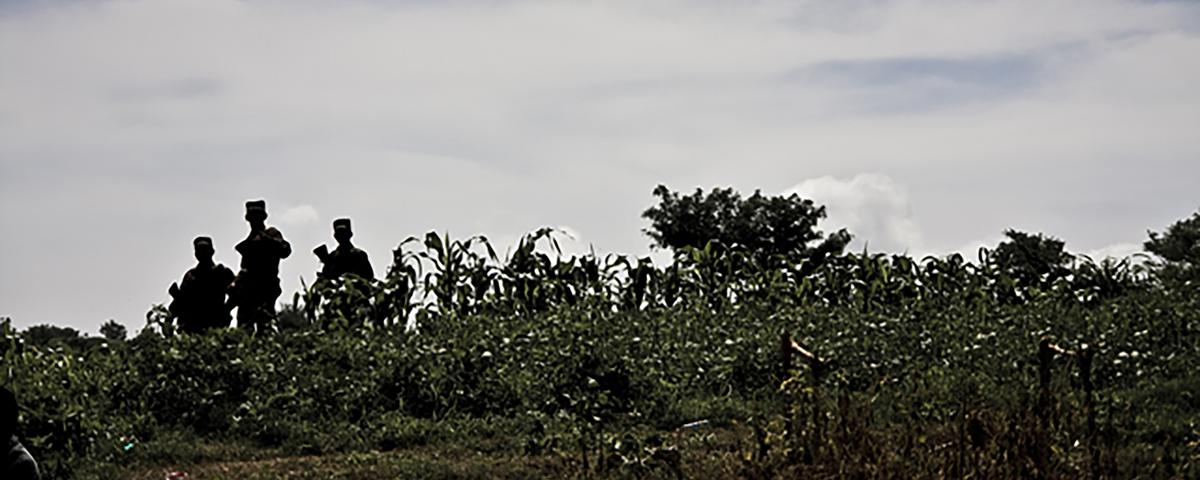
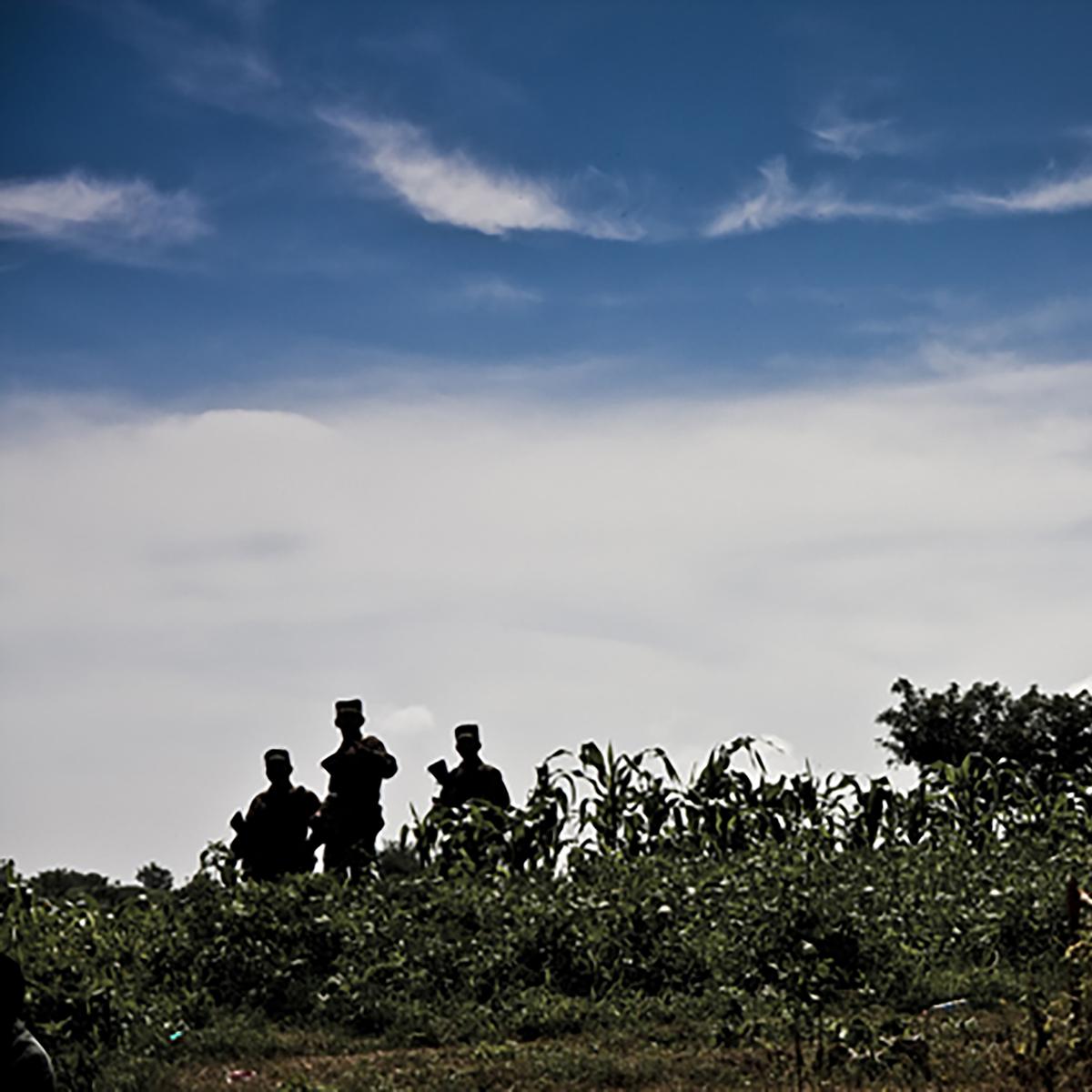
Two old men, their skin shriveled by the sun, are tending to their milpa on the slopes of a steep hill where small spears of corn peek up from dirt. The men have managed to coax the seeds to sprout in the inhospitable cliffs of this hardscrabble hill, helping the plants to outsmart the stone. It seems an impossible task, like trying to get a spoonful of salt pregnant, but there they are, the little green shoots, poking out of the craggy slopes. “They must have come through here,” the prosecutor says, assuming her role as guide. We continue on, eventually entering the coffee plantation, and trudge uphill through the deep shade of the coffee trees until we reach a narrow path that skirts the edge of a cliff. You can tell it’s been pouring rain for days, the ground has washed away, which makes out path even narrower. Our procession comes to a halt. This is the place we’ve been looking for.



***
Mid-2009. We don’t know what they talked about, or if they talked at all. Whether William tried to escape, whether he begged for his life. Whether someone explained to him why he had to die in the middle of a coffee field, why he would disappear that day. We don’t know if anyone there even knew why… We don’t know what happened before the blade of the first machete cut into his body. A deep cut. Still alive. Another blow. Alive. Another, another, another… It’s night, and a group of young men hack away with sharp machetes at another man who minutes earlier had been with them on a stroll. The killers believe it’s their duty to kill him—that he owed them his life, that what he did, whatever he did, was an unforgivable offense—and they don’t stop, even when the body is no longer living, even when its muscles twitch in involuntary spasms. More hacking, more hacking, more hacking. They cut the body into several pieces: the hand is missing fingers, the legs are missing their feet… His name was William, and he lived on a coffee plantation in Santa Ana.
At the bottom of a cliff lined by a narrow path, the homeboys dig a deep grave and dump William in it. Ever since that day, his mother has been angry… she thinks her son left for El Norte without saying goodbye, leaving her heartbroken. He did it before, after all, and maybe this time he made it, and is building a life for himself in the U.S. Maybe he’s fine, and will call her soon.
A while later, the Mara Salvatrucha will strike again, their suspicions this time falling on one of William’s killers, possibly for reasons as trivial as those that doomed the other. The gang will give the “green light”—la luz verde, the death penalty—and the target will turn to the cops to save his skin: in exchange for protection, he’ll snitch, denouncing his former his brothers in arms, who in turn will set out to kill him. The police will assign him a code as a protected witness, and will forbid any mention of his real name. The gangster-turned-snitch will show the cops the exact spot where they buried William, and the Fiscalía—El Salvador’s Attorney General’s Office—will take on the case. Then, sooner or later—most likely later—the case will wind up on the desk of a short, anxious man by the name of Israel Ticas.
***
June 2010. “Look at these fields,” the prosecutor says, fanning herself with whatever she can find. “They’re filled with dead bodies.” At the base of the cliff, angry swarms of massive blue mosquitos are devouring the poor prosecutor. She stays rosy-cheeked and smiling as she answers all of my questions.
“How many people do you think are buried there? Five?”
“Oh no, way more than that... When they bring in the excavators and start building here, they’ll have to stop every meter to remove a body.”
“So more like ten?”
The prosecutor turns her face to catch the eye of the police investigator; they both laugh.
“More, way more.”
“Fifteen?”
“More.”
“How many?”
“Many, many more. All of these fincas are full of bodies, hahaha…”
With the help of some exposed roots, we descend the cliff, slipping and sliding in the mud, to the spot specified by the protected witness, code-named “Louisiana.” The sky is still heavy with storm clouds that have yet to break, and all of us are suffocating in a haze of mosquitoes that, considering their size, may well come equipped with rows of sharp teeth. Israel and his two assistants clear the area with rakes until the ground is free of leaves and debris.
The investigator steps back to take in the scene. Something doesn’t add up. Something is not the same as when he came here with “Louisiana,” but he doesn’t know what, exactly... something has moved... maybe that tree... maybe it was the landslide…
Israel sees the cleared ground and starts working his magic: where we see plain, damp earth, he sees colors and shapes. Textures. We’re looking for a grave that was dug a year ago, and all we know is its approximate location and a single detail recalled by the witness: a large rock was placed on top of the mutilated corpse, then covered with earth. Israel stares at the spot and moves his jaw compulsively. Something is off. He pokes the ground and his instruments distinguish compact earth and loose earth; he follows the pigmentation and concentrates on a barely discernible semicircle. We dig down a few centimeters and he carefully examines the hole, before letting us continue. A few more inches and he pokes again at the soil, performing acupuncture on the earth with chopsticks, checking its color, and so on, until we manage to dig down a meter and the soil turns to thick mud. Nothing. No sign of anything. The police insist that the witness must have misled them, that the grave is empty, but something in the soil catches Israel’s eye. A few more inches down and we find a pile of rocks that looks promising. We dig out the rocks and... nothing. Our first hypothesis: the gang dug up the body and buried it somewhere else. This happens: the gang will get wind that the cops are snooping around and will decide to destroy the evidence before the excavation crew shows up. Everyone insists that our work has been a waste—but the earth is still speaking to Israel.
Two gunshots ring out and the officers, on edge, draw their weapons. They climb the cliff and take up positions... silence... then... nothing. A few day laborers are passing by and suddenly find themselves surrounded by armed police; they open their backpacks for the officers and continue on their way, muttering complaints. The gang just wanted to let us know they’re here, that they’re watching us undo their work.
The sky is still menacing us with mood swings, the miniature pterodactyls are still eating us alive, the ground is turning into a swamp, the police are demanding we leave this hell, and the earth keeps speaking to Israel in a voice only he can hear... until finally, we find our first treasure: hair. Human hair. A tiny strand with a little bit of flesh—an invaluable source of DNA. Good enough. But Israel sniffs at the mud, pokes his hands around the pit, listening for secret echoes... and there’s more. He digs with his hands, plumbing the depths of the ditch. “Get your gloves on, I can’t dig through all this by myself.” I squat down in the mud with my photojournalist colleague and we start combing through fistfuls of muck with our fingers, which is how, in the mire, in the palm of my hand, I saw William for the first time: squeezing a small, indestructible piece of white through my fingers. Later I learned it was a metacarpal: one of the 27 bones in the human hand. Then another appeared, then a nother: a metatarsal, one of the small bones of the feet... a total of 21 pieces of feet and hand. Then two teeth and two ribs, which someone had accidentally left behind after removing the body from its original grave. By this point, the earth had taken on a new smell: it was giving birth to a dead son.
We hit another layer of rock as the afternoon threatens to steal our light. But Israel can’t stop now. He finds a boot. A rotten, worn-out shoe with a trace of skin inside. In the boot, a foot is decomposing. The murderers forgot to take everything. They left small bits of the man they killed. They buried him in a pile of stones, they unburied him, they disturbed the site... and yet, William was born once more from this womb of mud.
As we leave the site, the afternoon spreads its softest colors to the horizon. Maybe it was the treacherous slope, or my apprehension as we traversed it, but I had failed to take note of where I was. Now I see it: an immense expanse opening up before me... El Salvador is a beautiful country, overwhelming beautiful, where the sky bathes the land in orange light and rolling hills sleep like peaceful giants. As the sun sets, our procession descends on foot down a hillside planted with corn, carrying shovels and gardening tools. And with us goes William, who is now just “21 small bones, 2 ribs, two teeth, and a boot with a foot.” He fits into a few paper bags.

Chapter II: The criminalist
The former headquarters of the Fiscalía is a luxurious complex of buildings with walls of blue-tinted glass, leased at a rate of $220,000 per month. On the first floor, a sign with white arrows directs visitors to the offices located on that level: “Alternative Dispute Resolution,” “Security Unit,” “Storage Area,” and... “Criminalist.” In the singular. A very apt singular, indeed.
If there’s one thing the Fiscalía can’t be accused of, it’s extravagance, at least when it comes to staffing. The sign at the entrance could have read “Israel Ticas,” with a white arrow pointing the way to the office of the only criminalist, or forensic investigator, employed by that institution. In other words, the only one in the entire country with that specific role.
Perhaps the easiest way to explain what a criminalist does is to say that it’s what the protagonists of the TV series CSI do. That is: it’s a science used in criminal law to investigate, explain, and prove crimes with the goal of presenting incontrovertible evidence at trial. Criminalists are the experts who collect and analyze this evidence: they examine crime scenes, create composite sketches, reconstruct cadavers, determine the date of the criminal act, etc. Once again, El Salvador’s Attorney General’s Office, which prosecutes upwards of 4,000 homicides a year, employs just one person in this role.
In a section of the criminalist’s office, at the base of a wall pinned with photos of mutilated corpses, sits the sofa-bed where the criminalist usually sleeps. A collection of stuffed animals and a few throw pillows are piled up on the couch.
Suffice it to say, any doubts about the nature of Israel’s work are immediately dispelled upon entering his office. If early humans decorated their caves with scenes of their daily lives—a herd of animals, a deer hunt—Israel has done something similar in his office, decorating the walls with photographs from his daily life: two half-rotten feet emerging from a large clod of earth... “An engineer, who was kidnapped,” Israel explains, as if dictating a caption. In another image, the criminalist himself holds the head of a woman by her hair, a small section of spine still dangling from the skull. In another, a woman’s skeleton has been dug up and her body lies on the ground, her legs spread wide. Another shows a man’s head, swollen and bruised: before killing him, his captors mutilated his penis, forced him to swallow it until he suffocated, then sewed his mouth shut...
An entire wall decorated with an unspeakable catalog of torture, bodies macerated, crushed, mutilated... 37 images that leave nothing to the imagination. It’s hard to look at for more than a few seconds. Israel tracks his visitors’ gaze with his own, making sure the display had achieved its repulsive effect. “This is the truth of things; this is how things are in this country, and I don’t want it to be hidden from anyone,” he explains with a satisfied smile. A shelf nearby displays a carefully arranged collection of human bones: a skull, a femur, and several others arranged by size. There is also a scale model of the ranch where Katya Miranda was raped and murdered. The victim is represented by a little clay doll lying limp on the sand.
Israel Ticas is not a criminalist by training. He was educated as an IT systems engineer, but never worked as one. He got his start in the investigations division of the once feared and now defunct National Police, and has been learning the tricks of the trade ever since: bone analysis, stages of decomposition, soil pigmentation, composite sketches, etc. On the wall above his desk are 14 certificates attesting to his participation in various forensic investigation conferences, from Israel to Argentina.
“A while back, some students stopped by to ask me about serial killers—there was this case of a guy who murdered homeless people... no big deal, he was a lunatic. But now we have a situation where every gang member in the country has killed a ton of people. They’re all serial killers,” Israel says, making small and controlled gestures, his jaw perpetually clenched. Today, he is dressed like an office worker, wearing well-polished black shoes, a blue tie, his shirt tucked into his pants, with a pair of tortoiseshell glasses that he uses when looking at the computer. He’s embarrassed to be dressed that way, and he insists on showing us pictures featuring his more personal look: stuffed into a space suit—actually a hazmat suit—and digging up decomposing bodies; in short sleeves, eating his birthday cake next to the mummified corpse of a woman; about to be lowered into a well, once again in a space suit, to retrieve, you guessed it: corpses.
He gripes about police work, cursing and ranting against the investigators who dig up bodies as if they were digging up old tires, who throw away clothing, wallets, knives, and glass bottles they find at crime scenes. “They throw them in the trash! I tell them: ‘Damn it, you idiots, this is evidence!’” Israel says. He shares a few anecdotes from the job, including a story about an inexperienced forensic excavator who accidentally split apart a corpse’s face with a shovel, severely compromising the crime scene; or the time he managed to extract 10 bodies from a 33-meter-deep well, thanks to a trigonometric calculation that enabled his descent to the bottom; or the words of advice he imparts to his female students: “Don’t let a gang member set his sights on you, don’t dress provocatively, don’t wear thongs—they’ll kill you!” In Israel’s world, this is the rhythm of life: a cadence of those who kill and those who die.
Israel is also an artist, but his source of inspiration is a song with the same sound: those who kill and those who die. He’s a meticulous sketch artist. He listens to witnesses and draws perpetrators’ faces from their memories, rendering the suspects on paper through the power of pencil strokes. Some of these faces hang on the walls of this office as well, juxtaposed to the photographs of the people they portray. It’s hard to believe these portraits were drawn prior to seeing the images of the real people. He’s a painter, too. One of his canvases hangs in his office: a woman lying on a wicker couch, her torso and pubis bare, a plethora of breasts piled one on top of the other.
His phone rings and, before he picks up, his expression changes and his swaggering smile vanishes from his face. He shakes his head regretfully. “This woman calls me every day,” he says, and puts the phone on speaker. On the other end of the line, someone is calling from the depths of hell, speaking in the voice of someone who was skinned alive.
“Hola, ingeniero, sorry to bother you…”
“Hola, madrecita.”
“I can’t take it anymore, ingeniero!” her voice breaks and she starts to cry.
“Sí, madrecita.”
“I can’t anymore, ingeniero... every day… every day…”
“Sí, madrecita.”
“Please, ingeniero, try harder, do something!”
“Even if all that’s left is his little medal, madrecita, I promise, we’ll find him. Stay calm, God willing, we’ll find him.”
“It’s too much to bear, I can’t take it anymore…”
“Sí, madrecita.”
The conversation goes on like this for several minutes. With each sentence the woman’s speech grows more slurred and drawn out; she complains of unbearable pain while Israel interjects with his impotent analgesic, “sí, madrecita,” through clenched teeth, his eyes glazing over, betraying his typical tough-guy façade, and every time she wails in anguish he hards his face and mutters that useless phrase once more.
The woman sobbing on the other end of the line is a mother whose son disappeared over a year ago—vanished, just like that, without leaving a trace. One day he was there, the next he wasn’t, and as time passed, his mother came to accept that her son was dead and buried somewhere in this graveyard we call a country. And ever since, she turns up at every excavation she gets wind of, bringing food and water and handing it out so that Israel and the excavation crew will let her stay, and then she waits like a puppy to see if the earth will vomit up the bones of her only son—but it never does. And her life is slipping away, and she calls, every day, to talk to the only forensic investigator at the Fiscalía, and every day, Israel has nothing to say but “sí, madrecita, sí madrecita,” as he sighs in frustration.
Israel knows who murdered the boy. The killer is a gang member and a protected witness. The killer led investigators to a clandestine grave, where the mother appeared to witness the excavation, and the killer ate her food and drank her water… and later, feeling sorry for her, the killer asked Israel to ask the woman if her son, when he disappeared, might have been wearing a small dolphin-shaped medallion, and yes, yes, she said, he had. And ever since that day, Israel has been waiting for the labyrinth of a legal system, the paperwork, a court order, a police investigation, something, anything, that might allow him to speak with the murderer once more, so that Israel can ask him where he killed the boy and where he buried his body.
Israel hangs up the phone, his face contorted with rage, and huffs several times before he’s able speak: “Damn it, damn it!” he says, avoiding my eyes and clenching his jaw... “It’s a fucking waste for me and I’ll have to deal with it all myself!” Little by little, the muscles in his face relax and the crazed fire in his eyes begins fading away, as he remembers, perhaps, that such is the rhythm of his life: those who kill and those who die.
There’s an awkward silence that needs to be broken and it occurs to Israel that he should show us one of his prized possessions: a gargantuan daily planner that looks more like an accordion, impossible to close, its front and back covers almost perfectly perpendicular. Inside are endless scribbles, sketches of excavations, and another collection of gruesome photos. Israel is obsessed with collecting and capturing everything. Every day of his life is documented in photographs. If a group of students visits him in his office, he takes their picture, prints it, and puts it in his book; if he goes for a walk with friends, he does the same; if a journalist interviews him, he does the same… if he excavates a corpse, he does the same.
Flipping through Israel’s organizer is an exercise in macabre horror: unrecognizable faces, mummified corpses, “saponified” bodies—swollen, rotten, blackened—headless bodies, amputated limbs... He points to a shelf with a stack of equally swollen planners, featuring the same content but for previous years, that we opt not to open.
We say our goodbyes with side fives and fist bumps, but before we leave, he stops us: “Hey, you can’t just leave like that,” he says. “Stand against the wall,” he tells us, pulling out his camera. We pose for him, and he snaps a couple shots. Days later, he shows us his planner, and there we are, in that paper accordion, me and the photojournalist next to countless anonymous corpses.

Three officers in full uniform step out of a police pickup. Their sleeves are rolled down to their wrists, their guns holstered on their belts, their faces covered with black balaclavas. They’re not displaying any badge numbers. The group is on a reconnaissance mission that, due of its sensitive nature, requires that they conceal their identities.
We’re standing in the middle of a cornfield in Lourdes, Colón, under a scorching sun, though some of the detectives keep insisting a storm is coming. We’re searching for two bodies that are supposed to be buried somewhere under the cornstalks. We’ll call the people whose bodies we’re hoping to unearth, who were killed about a year ago, Sintia and Ramiro.
One of the three officers who got out of the pickup steps forward, and the other two follow him with their eyes. He wanders through the bushes like he’s sniffing something out, sensing for the precise spot where Sintia and Ramiro were murdered last year. He’s dressed like a police officer, but his mannerisms give him away. There’s something about the way he walks, the brazenness of his gestures, the way he searches the milpa... that makes it unnecessary for anyone to explain that the blue uniform is merely a disguise. He’s a young man, very thin, and the uniform fits him like a pair of loose pajamas. The gun on his belt is unloaded. A set of thick black eyebrows and two childlike eyes peer out through the slit in his ski mask, scanning the area for a clue that might help orient him. The other two officers—who are actually police—follow him like hawks; they don’t want their witness to take off running through the thicket, or for the department to lose that uniform, complete with mask and gun, along with him—they can’t afford to lose it.
The kid spots a large avocado tree and hurries over to point it out to the police.
“Here,” he says, tracing an imaginary rectangle with his hands.
“Which side is the head?” Israel asks, and the pretend cop hesitates, unsure…
“Over there,” he points, indicating that the feet are at the base of the tree.
“What am I going to find?”
“He was wearing sneakers and jeans.”
“How did they kill him?”
That last question is key to determining whether the witness is lying. Each clica, each gang clique, has its own way of killing, and its members consider it a kind of signature. Investigators and prosecutors, well educated in these matters, know how to identify this distinctive ritual, and to us it to determine whether a witness is telling the truth when he claims to have participated in a murder. This clica, the Lourdes Locos Salvatrucha, uses a noose.
The ritual is simple: some people immobilizes the victim while others loop a rope around their neck, trapping them in the middle by a noose. Then two men grab each end of the rope and pull as hard as they can in opposite directions. If necessary, a third man will punch the victim in the stomach to force the air out and make it easier to asphyxiate him. Death takes several minutes, and the killers listen to the victim choke and gurgle before their life slips away.
In Apopa—according to one prosecutor—they’ll cut a small length of barbed wire and wrap it around someone’s neck, then attach each end to a small piece of wood and twist it until the wire breaks the back of the person’s neck. It’s a process similar to the torture technique knowns as the garrote vil, used by the Spanish Inquisition. But right now, we’re not in Apopa or Spain—we’re standing in the shade of an avocado tree in Lourdes, over the clandestine grave of Ramiro, a member of Barrio 18 who was kidnapped and tortured to death by a skinny guy who is now disguised as a cop, and by his former comrades in the Lourdes Locos Salvatrucha.
Next, we need to find Sintia’s grave, but the milpa has grown tall and the landmarks are hard to make out. One night, about a year ago, Sintia came to this place of her own free will. She was 14 years old and in love. She had run away from home after stealing $2,000 from her mother, to elope with her boyfriend. That night, the two teenagers set out in the dark to find a secluded spot to make love. He led her to that remote place, near the ravine, where the others were already waiting. The gang had caught wind of Sintia’s small fortune and had decided to take it for themselves. Her boyfriend was in cahoots with the others. He was also a member of the mara.
The masked witness is looking for a vantage point to get a better view of the area, but the corn stalks are too tall, and there’s no way to see the ground. A tree sparks a memory, and he starts to see it clearly:
“Yeah, yeah… over here’s where we offed that slave girl… she was standing over here… we killed her on a slope like this… I sat down on a rock, it could have been this one,” he says, sitting down on the rock as if trying to find clarity in his memories. “We laid her down over here… we didn’t rape her…”
When he thinks he’s found the exact spot, he drops to the ground, pretending to be the victim, pretending to be Sintia, to give the investigators an idea of the position the body was buried in. Another group of officers cordons off the area with crime tape. The witness gets up from the ground, brushes the dirt off his clothes, and walks back to the pickup with the other two men in masks. He has just earned his freedom.
Once the witness identifies exactly where Ramiro and Sintia are buried, one of the investigators immediately rolls up his sleeves and gets to work with enthusiasm. He picks up a shovel and waits for instructions from Israel. His name is Lucas, and he’s the most high-tech tool the criminalist has for this case.
Since we don’t have metal detectors, or fancy gadgets like optical probes for finding bones in the earth, or state-of-the-art sound level detectors for mapping underground cavities, “Lucas is our best bet,” Israel says, pointing to the officer, who has already charged into the cornfield and is now digging multiple meter-deep holes.
The criminalist has no choice but to trust the memories of protected witnesses, who are tasked with recalling the precise place that they buried their victims, typically about a year after the crime—the average time it takes to investigate a homicide. In cases like this, where the body is in a cornfield, or on a vast sugarcane plantation, the crops weren’t there when the crime was committed, and later, when the plants grow, it’s almost impossible to pinpoint the location. More often than not, investigators will tear up the entire field before they find the victim. Fortunately for us, we have Lucas, with his exceptional talent for discovering bodies. His reputation precedes him: “Where Lucas digs, Lucas finds.” True as this may be, his reputation has little to do with anything more than luck, along with an unmitigated zeal for digging holes. Today, he’s joined by three geriatric assistants, kindly provided by the municipal government. This is Israel Ticas’s support team.
We’re least certain about the location of Sintia’s grave, so we start with her. Another gang member dressed as a cop arrives to corroborate the previous one’s account. He’s a tall, muscular man, and arrives flanked by three officers. He immediately starts recalling the events:
“Sintia was wearing a red or pink blouse... the other girl was wearing a pair of little gray shorts, but I only saw her after they’d killed her...
“The other girl? What other girl?” It turns out there’s another victim is buried here...
“Oh man! If you dig around down there, you’ll find like 15 of them,” the second witness says, pointing to the ravine and the impenetrable undergrowth surrounding the milpa.
Israel, the homicide prosecutor, and at least two investigators hear him say this. The gang put a hit on this man in retribution for snitching, one of the officers tells me. Mi perrito—my little puppy, my witness—committed an offense against the gang, and he’s been sentenced to die, the officer tells me. The second witness opted to join the first in solidarity, and the two decided to go to the police together. And now here they are, dressed as cops, helping to search for bodies in cornfields.
None of this is of interest to Lucas, who keeps digging meter-wide holes and smoking in the sun. Suddenly, his shovel hits something and he yells out. Israel lies belly-down on the ground, sticks his hand into the hole, and feels something that isn’t dirt. He inserts a probe with a light to photograph the object buried below... well, not a probe so much as my cell phone, whose weak flash fails to overpower the darkness. We widen the hole to fit a camera with a real flash inside. It’s the sole of a shoe. The object that Lucas hit is the sole of a man’s shoe. A plainclothes investigator is sitting on a rock nearby. Even though they just found something, he’s in a bad mood, because he came here for two bodies—two victims whose cases he’s been working on for over a year—and now it turns out there could be twenty or more buried below.
“He’s probably 18th Street. Let that son of a bitch rot—bury him again,” he grumbles, then continues filling out his tedious paperwork. More bodies mean more open cases, and he already has about 30 piled up on his desk. Way more than he can handle.
“You’re just like shorty over there,” Israel scolds the cop as he gestures at a young investigator, who’s already giving away his guilt. “That guy found five bodies the other day and then buried them back up…”
Shorty smiles sheepishly and mumbles an explanation that almost no one can hear:
“Well, yeah, I mean I was only looking for one, so they weren’t my responsibility.”
Israel shoots him a stern look:
“But I called him on it! They’re not dogs, man, they’re people,” he says, continuing to feel around the inside of the hole.
According to Howard Cotto, deputy director of investigations for the National Civil Police (Policía Nacional Civil, or PNC), the homicide unit is short a few investigators. Six hundred, to be exact. What little staff they do have are so overworked that agents will sometimes resort to re-burying the bodies of victims they weren’t expecting to find.
Israel cordons off a perimeter, making a square about three-meters wide by three-meters long. The idea is that the grave will be in the center, with pathways along each side of the large rectangular hole, like a room with a table in the middle.
The criminalist will need more hands for such an excavation, and he knows where to find them:
“Alright, journalists, I didn’t bring you here just to watch,” he says, and points to a pile of shovels and pickaxes. “First, we need to dig this square out a meter deep, then I’ll tell you…”
Little by little a hole starts to take shape, as two reporters with tender hands and three old men with more experience struggle with the dirt. Lucas lets out another yell. He’s found another body.
***
One of the three excavation assistants provided by the municipal government is a man who never speaks. He’s the youngest of the three, but this isn’t saying much. He thrusts his shovel into the dirt in silence, sweating buckets without complaint. He barely smiles when his colleagues crack a joke, and he seems incapable of getting tired. He’s a short, skinny, gnarled man with a faint little mustache that’s always glistening with sweat. Every so often, he casts a suspicious glance around, then goes back to digging.
The oldest on the crew, in contrast, is a man with no teeth who never shuts up. He’s not much for digging. His preferred activity is talking and laughing his toothless laugh. As it turns out, what he likes to laugh at most is the photojournalist. He thinks he’s tricked the Catalan into doing his job for him: “Man, this Spaniard is really good at his work,” he says, winking at the others, making them accomplices to his amusement. But as for digging… not so much. Honestly, though, his behavior is understandable: at that age, no one should be sweating in the blistering sun trying to dig bodies out of a cornfield. His skin is weathered, his legs are bowed, his is back hunched.
The third guy is an affable old man with chalk-white hair and a body like El Salvador’s classic comic book caveman Trucutú, his broad shoulders still capable of working the shovel to a brisk beat and delivering tremendous blows with the tip of its blade. He laughs at every joke his colleagues make and works without stopping, his shirt unbuttoned and his enormous belly exposed.
Suddenly, everyone falls silent. One minute they’re down in the ditch, digging at the rocky soil, the next everything goes quiet. All three men are staring at the ground and doing their best to hide their faces. I can sense something serious is happening, but they won’t let me in on the secret.
Finally, the oldest whispers without turning to look at me: “There they are,” he says. His face is set and he’s staring straight at the ground. All three men are staring at the ground, their eyes locked as if looking up might let loose the horrible dangers that apparently lurk there. They gesture to a wall. When I ask for an explanation, they tell me to be quiet, not to look, not to point, to crouch down. All three men are hunched over too, not so much working at the rocks as fiddling with them.
The only thing I can piece together is that, during one of his quick scans of the area, the lookout spotted some heads peeking up from behind a wall, and this was enough to send them into full-blown panic. They’re convinced it’s the gang, hunting for someone to punish for blowing the lid off their secret hidden in the cornfield.
“You go tell them,” the old man says without turning to look at me, still pretending to work, and I do as I’m told. The investigator listens to the report I relay, and without thinking, moves his hand to his sidearm. The atmosphere is already tense. Radios crackle and reinforcements arrive in record time. It’s a small squad, four men armed with long guns: rifles and submachine guns. Their commander is a hulking beast of a cop wearing a bulletproof vest over his uniform, with several magazines strapped to his belt.
I head back to the ditch. The three men haven’t let up their guard. Their mission, at all costs, is to keep their faces hidden, to be unrecognizable. The rules haven’t changed: hushed whispers. Once again, it’s the toothless one who lets me in on the game, showing me that the enemy is closer than we thought: he points to a nearby tree. Finally, I see it, a person peeking out from behind the trunk.
It’s obvious that he’s watching us. The tree he’s hiding behind is growing among the corn rows, and he’s using that to his advantage, blending in with the stalks. But he’s so close, and his brazen attitude has managed to scare me. Fortunately, we’re not the only ones who’ve spotted him. The Rambo in the bulletproof vest has already organized his squad and they’ve fanned out to hunt him down.
They spread out in a flanking maneuver, rifles at the ready. They move swiftly and silently, like in the movies, slipping into the cornfield without a sound, moving in well-spaced formation. By the time the enemy realizes what’s happening, it’s already too late. There’s no escaping the encirclement. He’s trapped.
“Come out,” the agent commands. The enemy comes out. “What are you doing here?”
“Watching over the milpa,” he replies without hesitating, his expression serious.
“Watching it for what?”
“So that the goats don’t eat it.”
“What goats? There aren’t any goats here, you’re spying.”
“No, I’m not, I swear.”
The more questions the cop asks the more nervous the enemy gets. The officer yanks off the enemy’s hat.
“What’s this hat say?”
“I don’t know.”
“‘I don’t know!’ ‘I don’t know!’ Stop playing dumb. It says ‘MS’ right here.”
And sure enough, on the front of the hat, in hand-painted letters, are the gang’s initials, and the initials of the clique.
“Are you with the gang?”
“No, not me.”
“Then what are you doing wearing this around?” The impromptu interrogation starts to wear at the enemy who struck terror into the hearts of the excavation crew, and he begins to cry.
“Please, don’t take me away,” he pleads, tears starting to stream down his face.
“Who gave you this hat?” the agent insists, sternly.
“Please, please don’t take me away,” the enemy says, and he cries and cries, just like children cry when they’re scared. Children his age. Because the enemy is maybe 10 years old, at the most.
The child’s crying cracks through the cop’s hard shell and he changes his tune:
“No, kid, we’re not gonna take you away.”
But the boy is already drowning in tears, terrified he’s being arresting. Instead, the police offer him some comforting words as they escort him away, disappearing down the narrow streets of Lourdes. They’re not arresting the boy; they’re taking him home to his mother.
“He was just a kid,” I say to the group of workers, who, with the threat now gone, have finally dared to look up. The old man grumbles:
“Yeah, and those little bastards will kill you!”
***
As the days pass by, what was once a milpa is starting to look more like a network of trenches. Whoever planted a cornfield on this plot of land fertilized with bodies has now lost at least half of his crop—and it’s only our third day of digging.
On average, it takes three days to exhume each body, depending on the techniques used and the staff on hand—men who, if they aren’t handicapped by their lack of experience in the art of shovel and pickax, are crippled by the years that weigh down their backs.
Once we’ve managed to excavate an underground chamber nearly two meters deep with our full-size shovels, Israel begins chipping away at the clump of earth in the center with his gardening trowels. The body is trapped in there. The trick is to dig out the corpse without moving it a single millimeter from the position in which it was originally buried. Using long, thin sticks, we perform acupuncture on the earth. When a stick hits a solid object, it’s likely to be a bone. If this happens, the stick stays stuck in that spot, poking out like a little flag. Using these sticks, the criminalist is able distinguish soil from skeleton. By the end of the first round, the clump of dirt looks like a porcupine. Next, Israel starts scraping at the earthen mound and bones begin to appear. The assistants are keeping busy on the sidelines, doing our best to wrap up the other tasks: removing the piles of dirt left behind by the criminalist’s procedure, digging a drainage ditch in case it rains, and, more than anything, trying to stay out of the way.
This is our third day on the job, and at this rate, we have at least six more days to go: three for the unidentified body Lucas found on the first day, and another three for the boy buried under the avocado tree. There aren’t enough of us to work at three graves at once, and in any case, there’s only one criminalist. Sometimes the prosecutors and police get tired of filling out paperwork and decide to get some exercise. The prosecutors hang their neckties on the tree branches, but there’s nothing anyone can do to get the cops to set down their guns.
The owner of the milpa arrives to assess the damage to his crops. He’s a shy man, and is clearly hoping to get out of here as soon as he can. He tells the police he had no idea know his corn was growing in a graveyard and he refuses the compensation that the prosecutor offers him. He says it’s nothing, that it was just a few plants, and he flatly refuses to accept a single penny from the authorities. The gang has eyes everywhere, and he’s afraid they might be watching him right now, watching him making deals with the cops, accepting their money, being buddy-buddy with them. Nothing can change his mind. As soon as he’s able, he vanishes into the corn. He’s learned to keep his eyes glued to the ground, to watch his own footsteps as he walks. According to data from Medicina Legal, El Salvador’s forensic medical institute, more murders were reported in the canton of Lourdes during the first half of this year than anywhere else in the country. Thirty-eight people were murdered between January and July. Thirty-eight people who had the privilege of dying in a ditch, of painting the streets with their blood. Thirty-eight people who had the great fortune of perishing on open ground, not disappearing under a cornfield.
The first body has already emerged. It’s not a man, despite the shoes still on the bones or the pants, which were probably too big even when the victim still had muscles and skin to fill them.
We know it’s a girl because a bra is tangled around her ribs, because long strands of dyed-yellow hair still cling to her skull, but above all, because she’s so small—because her shoulders are so narrow, because she looks like a sleeping child, curled up on a real bed, not decaying in this bed of dirt. We know because she’s covering her face with her arm, as if she were about to yawn, to stretch and stand up, because sitting next to her is a strip of eight lollipops, in colors so vivid, so distinct... and the fact that she looks like a little girl forces us to remember on repeat that no, she is a corpse with empty eye sockets that can no longer see the rope that left them without life: a sky-blue noose, cinched around a spine that was once a neck.
The earth did the work of digesting this girl down to her bones. Even if now she’s nothing but femur and fibula, a perfectly formed collarbone, a skull with clenched jaws and a fixed expression… even is she’s just a skeleton in clothes, I can’t stop seeing her as a girl with a noose around her neck. Maybe it was Sintia, who stole money from her mother and, searching for something like love, found death instead. Or maybe she’ll stay a skeleton with dyed hair forever, and no one—no one, not ever—will know who she was or why the hell someone would strangle her with a sky-blue rope.
Or maybe they will. Wherever Israel Ticas the criminalist goes a steady stream of questions follows, sometimes in the form of a woman crying over the phone, and sometimes, like today, in the form of people peering over police tape and asking questions as if asking anything was wrong, as if they were committing a crime: in hushed voices, staring at the ground, afraid of being overheard, scared shitless and overwhelmed with sadness...

A woman, 55 years old. She’s wearing a white apron. She’s very small and already looks like an old woman: “And you’re digging people up here?... My son was a catechist at the Iglesia Nuestra Señora de Lourdes, he was 30 years old, he was wearing black dress pants, a light green shirt, and black shoes... He was looking for his sister who also disappeared, that’s why they killed him, at least that’s what I was told... He had two little crown tattoos, right here on his forehead… How do I make sure they’ll let me know if they find him?”
A young woman. Thin. I can barely make out what she’s asking, she’s speaking in whispers: “He disappeared two years ago… He left for work and never came back… No, he wasn’t involved in anything, he wasn’t part of the gangs… We have two children… Not anymore... I’m alone now, I know he’s gone, I would have felt something by now... Where do I sign my name?... And will my face be public?”
A mountain of a man with white hair approaches the scene and stands silently on the other side of the crime tape. He just watches, his expression as stiff as a tree’s. He won’t let the emotion welling up inside him surface for even a second. He won’t let the trembling trapped somewhere deep within him disturb his composure. His wife can’t find peace, can’t move on, he says. When she sees on TV that police are digging up clandestine graves, she weeps and wails and won’t give him a moment’s rest and begs him to go and ask, because maybe this is the day their daughter who disappeared two years ago will be delivered from the ground... and so he goes, without hope, to another grave where his little girl won’t be found. He huddles with the others near a tree and begins the same ritual as the rest of the searchers: “She was 22 and the girlfriend of a gang member who’s in prison for murder now… Do you think her skin is still on her? It’s just that if I saw her, I’d recognize her right away… No, she’s not alive anymore; according to some statistics they gave me, she’s not... When I ask the Fiscalía, they just tell me something about informants and I don’t understand a thing... When I left for work, she was still asleep.”
Sometimes this is how they vanish: without a last gasp, without the drama. If you examine police records from last year for cause of death, it’s the same story: death snatches them while they’re going about their lives: “She was eating a sandwich when they shot her in the back”; “He was drinking liquor at home with three other people”; “She was working a shift at the tollbooth”; “He was walking from La Ventana [a bar] to La Luna”; “She was on her property harvesting mangoes”; “Two men shot him at a licuado stand”; “She was hanging out with her friends”; “He was on his way to play soccer when he was attacked”; “She came home carrying a bundle of firewood and they attacked her at gunpoint”; “She was washing up in the river when the gang attacked her”; “He was at work, picking up trash”; “She was flying a kite and was attacked by gang members”; “They took a kindergarten from her school”…
***
Every time a new clandestine cemetery is discovered, the searchers appear with their question: ¿has visto a mi muerto? Have you seen my dead loved one? They ask it huddled together, in whispers. And the answer is invariably the same: “no.” They ask the state, which appears to them in the form of a police officer bored of listening to the same stories, as an overburdened prosecutor, as a lone criminalist covered in mud who won’t stop slicing at the earth in search of the bones of their children.
As this scene plays out in a cornfield in Lourdes, the Legislative Assembly has just passed an extraordinary new measure aimed at combating this unending violence: A law that mandates all schoolchildren read the Bible for seven minutes a day. This is their plan for promoting national values. This is how our representatives have chosen to respond to the woman searching for her son, to the wife who can’t find her husband, to the man with a face like a tree’s asking on behalf of his girlfriend: pray, pray, you poor sons of bitches, pray because that’s all you have left! In a few days, the president will veto the measure.
Chapter IV: Investigation tactics
His belly full of beer, the youngest cop is in a good mood. We’re at one of the little bars that surround the El Cafetalón soccer fields, and this young man has more than a few Pilsners pumping through his veins already. He comes out to the street and greets me warmly:
“What’s good, Chelito?” he says, patting me on the shoulder.
Julián already has that slurred speech you get after a solid few of hours of drinking.
“Let me introduce you to some of my friends.”
Today was their lucky today: they managed to clock out early and have decided to celebrate. The place is not really a “bar” but a hole-in-the-wall dive crammed with drunks who can guzzle a bottle of beer in one gulp. The walls are lined with posters of sexy girls beaming in bikinis, dripping beads of sweat, just like the beers they’re advertising, and promising passionate kisses. These are the only women who are smiling in this place. The real ones are too busy ferrying heavy trays of beer and wearing aprons over uncomfortable miniskirts that do next to nothing for all that flesh and all those stares. The men, for their part, seem to have an unspoken agreement that if you don’t yell, you shouldn’t speak, and this dynamic divides the crowd into two groups: those arguing loudly, with their loose ties and worn-out work clothes, and those who barely have the strength to hold their heads up as they gaze longingly at half-empty bottles. The homicide detectives waiting for us at a table in the back belong to the first group.
My host introduces me to his friends and motions for a waitress to bring me a beer and put me in the mood. The other detectives greet me with less enthusiasm.
“Ok so what did you want to ask about?” Julián blurts out, eagerly.
“Well, honestly, nothing specific… what’s your job like?”
“Ok, look, basically what we’re trying to do is break up the clicas. So, when there’s a murder, the first thing we do is try to find a witness...”
Julián is the youngest of the group; he’s not even 30, and has only been a member of the DIHO—the PNC’s homicide unit—for a few years. Practically shouting, he tells me about his work and explains his process of investigation. In short, the trick is to convince a marginal member of a clique to rat out his homies and help locate bodies. Then they have to protect the witness so that he makes it to trial alive, and this, Julián says, is how they manage to put some murderers behind bars. A broad-shouldered man with a stern expression jumps in:
“When you detain a group, you question them and take notes... that’s when you start to see who might talk and who won’t. Some guys won’t say a word, and if you let them get to you, they’ll intimidate you, sometimes just with their eyes, other times they’ll threaten you outright.”
“And what do you do with guys like that?”
The serious-looking man exchanges glances with Julián, then settles back in his chair. Julián picks up the explanation:
“Look, the thing is, these things aren’t legal, because of all the human rights stuff... You know what I’m talking about.
“So, you beat them?”
“Some of them, yeah. Some of these guys just need a good thrashing... I mean, look,” Julián says, with a look of disgust, “some of these assholes aren’t even human anymore, they’ve killed shitloads of people, they don’t give a fuck anymore.”
“So how do you get them to talk?”
It’s a rhetorical question. In all the time we’ve spent with Israel Ticas, we’ve heard plenty of similar stories, none of which are at all unusual in El Salvador: slaps to the face, hoods filled with talcum powder, guns to the head, twisted testicals, death threats, threatening to drop people in the middle of a rival gang’s territory...
“And how do you keep them from filing complaints against you?” I ask, and the serious-looking guy speaks up:
“Well, for one thing, you don’t hit them in the face, you hit them where it won’t leave a mark.”
Julián jumps in:
“And by the time the trial comes around, the bruises have already faded!”
I understand where they’re coming from. I understand because I’ve asked myself: what I would do if I were an underpaid cop (they earn less than $300 a month) drowning in a desk full of cases that each take almost two years to solve (Julián has handled as many as 25 at once), having to respect the human rights of a guy I know for a fact is a murderer... What I don’t understand is why they’re telling me all this. If I feel guilty for empathizing with them, why are these elite investigators so nonchalantly telling a journalist that they torture potential witnesses to make them talk? It must be because they’re convinced that they’re in the right. And don’t expect this reporter to be the one to cast the first stone.
“But Julián, if the cooperating witnesses are murderers, why does the state lets them go afterward?”
“To catch the whole clica... but in the end they always wind up getting killed anyway.”
The most expeditious method for investigating a case—and the most common one—is to rely on cooperating witnesses. They’re useful for everything: finding bodies, mapping gang structures and identifying members, testifying in court... From the moment they start cooperating with the police, witnesses are given safe houses to live in and enjoy regular meals often paid for by the investigators themselves.
I get the sense they’re not in the mood to talk about work anymore, but want to unwind with a few more beers. I close my notebook and gesture the waitress for another round.
Chapter V: Christ at the door
Despite all signs and predictions, it never did rain on this clandestine cemetery that was once a cornfield. If a storm did come, it came at night, and was less a downpour and more a light drizzle that barely left a drop on the graves.
The officers on night watch for the past 15 days of digging spend their shifts sheltered under a canopy, in total silence, warming their hands over small fires fueled by tiny twigs. They stay up all night with their holsters unfastened and their safeties off. They don’t have time to think about the dead; their entire being demands that they focus on the living, that they keep their nerves sharp and their guns close, very close, to their hands—until dawn breaks and they thank God for the light that’s finally come to illuminate this place of horrors.
Since we started the search for Sintia and Ramiro, the bodies of two more unidentified girls have also turned up: the teenager who sold candy, with her colorful lollipops and sleeping pose, and the girl with the skeleton of a small child. This second victim emerged from the earth with her jaw stuck in a scream and a noose around her neck. When she was pushed into the pit, her body curled up, like she was taking a bath in a basin of dirt. When she was dumped in the hole, her jeans and underwear were pulled down to her knees.

In Sintia’s grave, which was eventually located by Lucas, the body left behind a white, waxy residue known as adipocere, a soap-like substance comprised of calcium, potassium, and salts that forms when human fat decomposes under certain conditions underground. This is all that remained of Sintia: adipocere.
The last victim to appear was Ramiro, and the first thing to surface from his grave was a kneecap. Of all the bones in the body, the kneecap is perhaps the least bone-like of all: it’s a small, nut-shaped piece that, if it hadn’t appeared nestled between the femur and tibia, would have looked just like a rock. The kneecap is a simple bone.
Israel carved out that corpse with a name, sculpting the clod of earth that held it captive, and thus Ramiro emerged. His hands were tied above his navel, that signature noose still looped around his neck. Israel cleaned every last bit of dirt from Ramiro’s hands, giving his bones a meticulous manicure. It was almost pleasurable to watch him appear, to see the criminalist sculpt his bed of earth: everything seemed to come together suddenly. It’s a process that has something to do with beauty, though I’m ashamed to think it.
It’s our last day of digging and I stand at the edge of the pit as Israel puts the finishing touches on Ramiro’s body. He’s cleared the scene of all of reporter-assistants (the old men sent by the city left after the incident with the boy) and is focusing on the fine work. This body has a gentle demeanor, like an old man listening to children tell a story. They pulled Ramiro’s pants down too, before they buried him at the base of the big avocado tree. It’s taken the criminalist three days to make his bones perfect, without moving anything at the scene a single millimeter: the ribs are suspended in the air with a system of earthen pillars, the legs are still bent, every rope is in its original place... He sweeps his crime scene and carves the walls of earth to make the mound have perfect right angles. This isn’t necessary at this point; it’s pure professional vanity.
As Israel cleans the gaps between Ramiro’s teeth, the forensic examiner from Medicina Legal appears, immaculate in his white gown, and with his typical sense of humor:
“Hey, Mr. Engineer, are you giving this guy a fluoride treatment or what? Ha, ha, ha, ha…”
At this point, I’m pretty tired of the bone jokes: cops asking if you’re in the mood for some soup, prosecutors praising the virtues of a thong tangled around a sacrum... After 15 days, I’m sick of it, and in my notebook, I discreetly jot down “idiot” next to the name of this comedian-doctor. The dirty work has already been done.
It took almost 21 minutes to put Ramiro into seven paper bags, similar to the ones bakeries use to wrap up bread rolls.
* * *
A half-built evangelical church stands at the entrance to the milpa. It’s called “Iglesia Cristo a la Puerta” (“Christ at the Door Church”) and apparently—a parishioner tells me as he underlines verses in his Bible—it’s always been half-built like that. The church has been here for several years. It was here when the four young men we unearthed over the past 15 days were murdered. The man takes his hands off his holy book and points at the lot behind the church, whispering: “I don’t go back there anymore. I went there once to harvest avocados, but I don’t go there anymore.”
Today, this plot of land planted with corn is a system of trenches with traces of adipocere. It will be very hard for anyone to plant anything, or bury anyone, here again… but who knows.
Chapter VI: ‘Mis muertitos will have to wait’
It’s been a few months since we last saw each other. During that time, some things have changed: the Fiscalía moved to a new building, and they gave Israel a slightly larger office. He took his time decorating it, making it homey—according to his own particular sense of feeling at home. He put up his diplomas, his police sketches, his paintings, his gallery of mutilated heads, dismembered bodies, and corpses that never stop screaming. I think he might have even expanded it, even, because I don’t remember seeing this photo of a face that looks like it was shredded with a chainsaw.
Bellow the wall décor sits Israel’s old sofa-bed, where he still spends many nights, his dreams stewarded by these tortured dead. Viewed as a whole—sofa and photo gallery—the furnishings appear as an altar to madness: decapitated heads next to a stuffed-animal kitten, a wooden parrot, a fuchsia throw pillow, a maté gourd... Over these past few months my idea of Israel has been evolving. At first I thought he was clinically insane. Now I’m confused. Most of the time I actually think he isn’t as crazy as he ought to be, or at least not as crazy as I would be in his shoes.
One thing hasn’t changed. The same sign still hangs at the entrance to his office, announcing his profession in the singular: “Criminalist.” Israel is still the only specialist of his kind in a country where 11 people are murdered every day and the justice system’s conviction rate stays in the single digits.
A lot has happened since we were last together, searching for bodies: Israel exhumed 14 victims from a clandestine cemetery in Suchinango, two in Apopa, another in Soyapango, five in Ateos...
Also, a group of gang members kidnapped a police cadet, tortured and beheaded him. The victim’s head was found in the middle of a highway, but no one knew where the body was until the criminalist found it, buried in a neighborhood in Soyapango. In San Juan Opico, in the department of La Libertad, another man decided to take revenge on a woman who had rejected him, hurting her where it hurt the most—by attacking her six-year-old daughter. He hid in a coffee field, lying in wait for the girl. He kidnapped her, took her deep into the rows of coffee, and forced her against a wall. He killed her there, using a small, blunt-tip machete that campesinos call a cuto. The police found the girl’s decapitated body. Later, the murderer would confess that he had thrown her head into a well. Shortly thereafter, a man in a spacesuit would descend into the well’s cylindrical darkness and come back up holding a bag.

This man speaks with corpses. “Sometimes people ask me why I talk to the dead. It’s because I feel there’s a connection between me and the corpse,” he says. Recalling the time he rappelled into the well to retrieve the girl’s head, he says he could barely make out a faint light high above him. “I was down there with my oxygen tank and I saw the girl’s head inside the bag and I saw her black eyes looking at me and I held her and moved her hair to the side and her black eyes were staring at me... I remember that I spoke to her. I said, ‘Princess, why did they do this to you? We’re getting you out of here now, I’m going to help you up carefully, so you don’t hurt yourself.’ I’ve learned to love the dead, to talk to them.”
“Is that why your office is decorated with all those gruesome photos?”
“I don’t just have photos, I have bones, skulls… people might call this a chamber of horrors, but I don’t see it that way. It doesn’t scare me at all, and it doesn’t make me sad to look into the eyes of a decapitated head. I can tell from the way his teeth are clenched that he was beheaded while he was still alive. The bodies speak to me. I see the body of a mother with her two children lying on top of her, and she says to me: “I died with honor, because I defended my children to the death.”
“Is there beauty in death, Israel?”
“There’s beauty; that woman is still beautiful. Even as a corpse, she’s beautiful, and you can even find beauty in a skeleton, in the way it lies. That’s why I treat them like they were artifacts in a museum, because to me, this is an art. In Lourdes, I photographed three little girls: one had beautiful wavy hair… except she was a skeleton, a skeleton with hair, and I spoke to her and said, “You must have been beautiful.”
“You’re crazy.”
“Yeah, I’m crazy, but I feel happy being crazy, because I see myself as a lunatic with a positive attitude.”
“Positive how? If you’re craziness means plastering your office with pictures of corpses!”
“Not just my office, my belt, my shirt, my boxers, my socks, my tie, they all have skulls on them. That’s just who I am. I’m so obsessed with death, my mom calls me Satan’s sidekick. But I don’t believe in the devil. You know what? One time I dreamed the devil came to me and told me he was going to take me away, and I told him I didn’t believe in him and that he didn’t exist, and he turned into Jesus wearing a tunic, and you know what I did? I stuck my finger up his ass and told him, “You’re not Jesus, you’re the devil; get lost, devil, I don’t believe in you.”
“What is death like in this country?”
“I’ve never seen anyone kill the way Salvadorans kill, not even in the movies! In Joya de Cerén, they’d kill people with a barbed-wire noose and each guy had to take a turn twisting the wire until the person suffocated. Everyone participated. Once, near San Martín, I dug up a woman’s mother, son, and brother. They had all been hanged, but I was confused because there were no trees, just stumps. It turns out the killers had tied one end of the rope to a stump and the other around their necks, then they yanked at them by their feet until they died. In Chalatenango, they cut a person into 14 pieces, dug a circular hole, then carefully arranged the pieces before burying them—arms, legs, torso, abdomen, head. When I dig them up, the body parts looked like a wine glass, or like a beer keg. Another time they cut off the person’s head and placed it at his feet, facing his body; that was over in Opico. Near Lourdes, they lay the women down, rape them, then leave them with their underwear in their hands. They don’t dismember them, but they leave them in a position that suggests they’ve been raped.”
“Are women killed differently?”
Of the 395 cases I’ve seen, 80% are women. Men die in a more dignified way—maybe at most they’re decapitated or dismembered—but most of the women I’ve found have been decapitated and raped, they’ve had objects put in their vaginas—I’ve found razor blades, bottles, sticks, stones, stakes, knives—and the level of torture they’ve endured is just... my god! Over in Cojute, they string women up like piñatas and hack them to death with machetes. I’ve found victims with as many as 200 stab wounds. These guys’ minds have totally atrophied, and you know, as Salvadorans we like to stand out, so if one guy kills a certain way, the next guy tries to outdo him, and so that’s how we’ve reached this level of barbarity.”
“Don’t you find your job frustrating?”
“Yes, because I can’t keep up. I’m trying to do the work of seven or eight people. Right now, there’s a well with five people, a clandestine cemetery with three people, another with five people, and the bodies are all calling to me. But I can’t be in multiple places at once, and it breaks my heart that my little dead ones, mis muertitos, will have to wait. I can’t make copies of myself, and it pains me because mis muertitos have to wait.
“Do you know the story of Sisyphus?”
“No.”
“He’s a character that reminds me of you: a man condemned to a futile, never-ending task, and no matter how hard he tries, he’s always forced to start over.”
“Yeah, that sounds like me, that’s how it feels to do what I do. I make works of art so they can be destroyed. It takes me 17 days to make them and then Medicina Legal destroys them in minutes. It’s part of the process, and the next day I’ll do it all over again. While I’m digging up one, they’re finding three more.”
“Do you think there’s any hope for this country, Israel?”
“No. Things are getting worse every day. The cadaver postures I would see in 2004 are nothing like what I see now. The level of violence is increasing every day. I wish there were more people working on this. I can’t do anything, I’m one person, I’m the only one. But I’ll never give up; I won’t say no to anyone.”
“And when you’re old and your back and arms are too weak to dig in the dirt?”
“Every day I ask God to keep me healthy, to protect me from catching anything from the corpses I deal with, and when I can’t do the work anymore, to help me train others... I’ll be supervising. I don’t think I’ll have time to write books.”
“Doe God exists, Israel?”
“He exists… when I wake up, when I do something, yeah, he exists, and I’ll ask him to help me, but when I’m on an excavation, I do sometimes wonder: if he exists, then why is this happening? Why did this 6-year-old girl have to be mutilated? Why did she have to suffer and cry when she was just barely starting to live?... I guess God must be a father who’s abandoned us.”
“Is there life after death?”
“No, I don’t think so… when you die, you die. I have a saying: When you die, you’re buried, you rot, then Ticas the engineer comes and digs you up. That’s my motto.”
*Translated by Max Granger