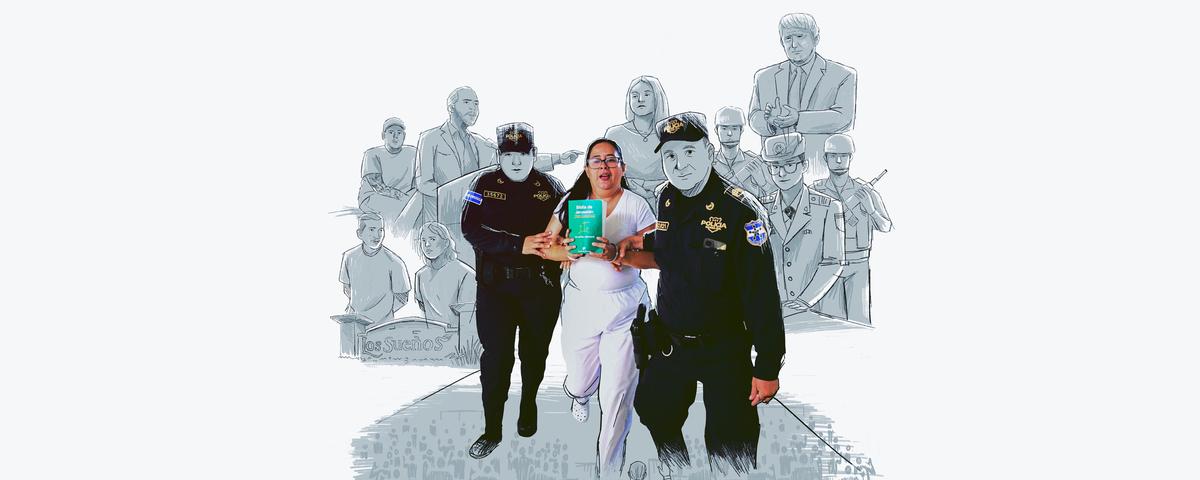
The Salvadoran dictatorship sent an eloquent message to its critics with the capture of Ruth López on May 18 of this year: It demanded silence, that no one complain, that no one raise their voice. Anyone who speaks out, the message announced, will go to jail. December 1 marked 197 days since police officers took Ruth from her home to arrest her. After that night, police visits to the homes of activists, human rights defenders, and even journalists took on a new meaning: It became clear that they did indeed pose a real risk, and as a result, many ended up going into exile days or weeks later, after noticing an increase in threats in May.
Ruth López, a 48-year-old Salvadoran lawyer, needed to be silenced before her allegations and truths reached more ears, and before her popularity made her capture more difficult and costly. That is why she was arrested.
Since May 11, 2021, she had been the head of anti-corruption and justice at Cristosal, a leading human rights organization in Central America. But even before working there, she had already made Nayib Bukele and his people uncomfortable. Ruth, for example, filed a lawsuit on February 10, 2020, asking the Constitutional Chamber to prohibit Bukele from using the Army for partisan purposes. The Chamber issued that order after Bukele took over the Legislative Assembly with police and soldiers and threatened to dissolve it. Since then, Ruth has not stopped. Approximately every month and a half, she has filed complaints against corruption or legal violations with the Court of Accounts, the Ethics Tribunal, the Constitutional Chamber, the Attorney General’s Office (FGR), and the Office of the Human Rights Ombudsman (PDDH).
In other words, Ruth kept Bukele in check like few others, using the tools at her disposal. She investigated clues of corruption, wrote reports on her findings, engaged in strategic litigation, and, even when there was no response from the state, used all social media platforms to share her discoveries. She had 16,000 followers on TikTok and another 32,000 on X. She is, as mentioned a few weeks ago in London at the ceremony where her husband received the Magnitsky Award on her behalf, “an all-round lawyer” who “holds the authorities to account.” The award is given by a human rights committee named after Sergei Magnitsky, a Russian lawyer who uncovered a huge corruption case involving Vladimir Putin in 2007.
On the Sunday of her arrest, the version that circulated among journalists and activists was that the police had tricked her into leaving home without an arrest warrant, using words that by then were part of the national vocabulary of arbitrary detention: “We’re investigating a crash,” “we want to talk to the owner of the vehicle.” They tried; they told the usual lies, but no-one fooled Ruth. She knew that the car accident was an excuse. She knew that they were actually after her, that the day she had predicted at least a year and a half earlier, in a conversation with her friend Malcolm Cartagena, had arrived.



Her husband, Louis Benavides, answered the door to the police and then went upstairs from the garage to tell Ruth that the officers were asking for her. “She told me to get her documents and said, ‘Record this,’” Louis recounts. The police kept on with the lie for a few more minutes: “Yes, everything seems normal with the car,” they said, but seconds later, a police officer got out of the patrol car and ended the charade. “Excuse us, we’re doing a job we’ve been ordered to do. We’ve brought you an administrative arrest warrant from the Attorney General’s Office.” And then Ruth said the words that were immortalized in that audio recording her husband managed to make from a phone hidden in his pants: “Have some decency, one day this will all end. You can’t lend yourselves to this.”
She never discussed the possibility of being arrested with her husband, but from what he saw that night —her face, her calmness— he now thinks it was something she expected: “She knew she was going to face this sooner or later and that for her... How can I put it? It would look bad if she tried to avoid them; she wanted to do something more appropriate... I can’t find the word, something honorable, I guess. With honor, dignity, as if to say, ‘I have nothing to hide, here I am.’”
The police could have arrested Ruth without that false prelude, but then they would not have sent the message of terror to all of Bukele’s critics. The dictatorship continued to use the police to intimidate activists, journalists, and their families with the story of a car accident. Many people went into exile after receiving police visits like the one Ruth received. Many people fled because the regime decided to arrest her, of all people, who had gained so much visibility in the world.
Bukele Ushers In a New Era of Political Prisoners in El Salvador
The message from the Salvadoran dictatorship resonated with dozens of people and organizations. Veteran journalist Jorge Beltrán, who went into exile almost a month after Ruth’s capture, sums it up in one sentence: “Ruth was internationally recognized and had a great reputation. I thought: if they do that to her, what can't they do to me?” There was no international journalist who did not quote her or Cristosal when talking about corruption or human rights violations by the Bukele regime. Just seven months before she was taken from her home, the BBC had named her among the 100 most influential women on the planet for 2024. Among the lines with which they presented their recognition were these: “Her work has become more prominent as, earlier this year, El Salvador re-elected president Nayib Bukele for a second term in office. Bukele, who saw his popularity soar following a crackdown on crime, has described himself as “the world's coolest dictator.’” They also explained their selection as follows: “We were looking for candidates who had made headlines or influenced important stories over the past 12 months, as well as those who have inspiring stories to tell or have achieved something significant and influenced their societies in ways that wouldn't necessarily make the news.”

Ruth was named a prisoner of conscience by Amnesty International, an organization that has been promoting the defense of human rights around the world for decades. Amnesty stated in its designation that the charges against her appear to be unfounded. She is not the only one in this situation in El Salvador. In 2021, the Committee of Relatives of Political Prisoners and Persecuted Persons (COFAPPES) was formed, which by October 2025 had already counted 35 political prisoners.
In 2023, the U.S. State Department identified 11 cases of political prisoners, including former mayor Ernesto Muyshondt, of the right-wing Arena party, who was sentenced to 18 years in prison for electoral fraud in September. Political prisoners exist in El Salvador today, just as they did in the years before democracy.
When Amnesty International designated Ruth a prisoner of conscience, it also did so for environmental lawyer Alejandro Henríquez and pastor José Ángel Pérez, both of whom were arrested a few days before Ruth. They are being prosecuted for public disorder and resistance after a peaceful march near Bukele’s home on a road leading to the Port of La Libertad.

She was an expert on certain topics, but above all, she was tireless in sharing that knowledge. In January 2025, during a meeting of organizations and academics in Guatemala City, just four days after Donald Trump’s return to the US presidency, Ruth shared her analysis of the implications for Central America: “There will be authoritarianism for a long time,” she wrote in a PowerPoint presentation. “Democracy will not matter; there will be abuses of emergency powers; cooperation will be shut down; and authoritarian regimes that prioritize security and control under the discourse of sovereignty will deserve Trump’s favor,” she continued. “She had the foresight to know what was going to happen before things happened,” says her husband Louis.
Since her arrival in Cristosal in 2021, she has proven to be an authoritative voice on corruption issues. She filed numerous lawsuits against public officials. She denounced Osiris Luna, director of prisons, for using prisoners to build a beach ranch for a friend of his mother’s, and for appropriating thousands of bags of food purchased by the state to deal with the Covid pandemic. She also secured the dismissal of the husband of ruling-party deputy Rebeca Santos, who had been appointed to a state office through an irregular procedure. She made 120 requests for public information; investigated 15 cases of corruption in Agriculture, Health, Nuevo Cuscatlán —the municipality where Bukele first won elected office as mayor— and the Ministry of Public Works. She also asked prosecutors to investigate irregularities in state works, scams involving crypto assets and the Chivo Wallet, and state construction projects in which Bukele’s relatives were involved.

But her passion has always been electoral issues. Like few others, she was able to explain in videos, reels, X threads, interviews, and articles how the dictatorship had been consolidated: the coup against the Constitutional Chamber, the replacement of judges, the co-opting of the Institute for Access to Public Information, the persecution of opponents with spurious accusations, the elimination of public financing of parties, the reduction of the number of legislators and mayorships, the change in the electoral formula for distributing Assembly seats, the accelerated electoral calendar...
Ruth was Eugenio Chicas’ chief advisor when he was president of the Supreme Electoral Tribunal (TSE) between 2009 and 2014. Partly because of her advice, Chicas made enemies in his party, the FMLN, and ended up distancing himself from President Mauricio Funes. Ruth and Chicas decided to comply with the resolutions of the Constitutional Chamber, even those that were politically and electorally damaging to the party. The dispute with Funes occurred during the presidential election on February 2, 2014, when the TSE banned a propaganda spot that the Presidency aired before the polls closed. Seconds after announcing the sanction on national television, Chicas answered a call on his cell phone. It was Funes: “You and I are not in the same boat,” the president complained. “I did it because it was my political duty,” Chicas replied.
Contrary to the usual suspicion of FMLN militants, Ruth answered calls and messages from journalists, even late at night, to explain in detail and with patience the complicated legal issues behind each vote. “If I know anything about elections, it’s because of her,” says Malcolm Cartagena, her longtime friend and former colleague at the TSE. “When Ruth joined the Tribunal, she changed the way we worked. She built a team and, as she learned, she began to teach the rest of us,” he adds. They became such specialists that even the Constitutional Chamber for the 2009-2018 term consulted them in advance on some of the resolutions it issued on electoral matters. “Even those from Nuevas Ideas [Bukele’s party] called us when they wanted to understand certain things,” says Malcolm, with whom she formed an informal alliance to charge for studies and consulting services.
The morning after Ruth’s arrest, Malcolm was devastated. A very active social media user, he chose to remain completely silent during those first few hours. He saw on social media that the Attorney General’s Office was accusing Ruth of embezzlement — that is, of allegedly appropriating public funds while she worked, like him, with Eugenio Chicas at the TSE. But Ruth never managed public funds in her position as an advisor. “The smart one gets a slap on the wrist, and the fool gets beaten with a stick. If they are accusing her of having ties to Eugenio without having handled public money, what’s stopping them from accusing me of the same thing?” he thought.
While Ruth was reported missing by her family in the early hours after her arrest, Malcolm began preparing to leave the country. He went to renew his passport and take care of some pending matters. On June 25, police officers in an unmarked vehicle arrived at his home with questions for a supposed census. They asked him if he had basic services, internet, water, and wrote down his answers in a random notebook. “It didn’t seem like a real census,” Malcolm says. The police left, but soon returned. Half an hour later, Malcolm was on his way to Guatemala.
It makes perfect sense that the regime would be interested in silencing expert voices on electoral issues in 2025. A November monitoring report by Acción Ciudadana says that the TSE is failing in basic aspects of electoral integrity. It declared confidentiality on relevant information about the purging of the Electoral Registry and denied information from the unit that oversees private financing of political parties. There is also no approved electoral calendar or election budget, both of which should already be known. And as if that were not enough, the TSE has not allowed the Electoral Oversight Board (JVE) to oversee its work, as required by the Constitution. Everything indicates that the Court does not want critical voices. In early August, police arrived at the home of Wendy Alfaro, director of the Vamos party, the most critical of Bukelismo in the Legislative Assembly. They arrived at her home under the pretext of conducting a census. Alfaro went into exile a few days later.

Among all the voices critical of electoral reforms, corruption, and lack of transparency, Ruth was perhaps the most popular due to her intense activity on social media, as well as her teaching and her visits to communities on weekends to talk about corruption. “Today we went out into the field. Twenty-eight young people (aged 19-22) from various communities talk about their experiences with corruption. They know. Happy Sunday afternoon,” she wrote on X on July 7, 2024. “Today there was #PopularEducation on Anti-Corruption and Transparency. Being and acting as a citizen is a necessary challenge in our country (today and always) #SomosCristosal,” she wrote on September 13, 2023.
There were parties such as Nuestro Tiempo that offered her a candidacy in the presidential race for 2024. The attempted alliance of parties and civil society in 2023 also offered her a candidacy. But she always rejected the offers. To be a representative for San Salvador, for example, you need 59,100 votes. Ruth collected citizen signatures to challenge the constitutionality of the mining law passed in December 2024. She presented 59,906 signatures to the Supreme Court of Justice on March 24, 2025.
State Cynicism
After her arrest, Ruth was held incommunicado for at least 32 hours, despite the fact that her closest relatives went out of their way from the very first minute to maintain contact with her. Lawyers and relatives knocked on the doors of police stations and jails, but no-one would tell them anything. When the Office of the Human Rights Ombudsman (PDDH) received a complaint about the arbitrary detention on May 20, there was silence until more than two months later, on July 31, when an official gave a half-hearted response. It had been 74 days since her arrest. The PDDH official said briefly that they had requested information from various authorities and that, to date, they had not been able to visit her in the prison where she was being held, the Izalco Penitentiary Farm. Almost six months after her arrest, on November 13, Raquel Caballero, the head of the PDDH, confirmed that she had seen Ruth for the first time. On the YouTube channel of Romeo Lemus, a former journalist turned regime propagandist, the newly elected official spoke mockingly about beauty tips: “I want to go see her again to see if they can straighten my hair, just like hers, because she has decided to study cosmetology.”

As the Bukele-controlled state apparatus buries Ruth in opacity, troll farms affiliated with the dictatorship have done their part to try to tarnish her name. From the moment of her arrest —including the publication on X showing her handcuffed, next to a patrol car and two armed police officers— she was showered with attacks and insults. She was called a “bitch,” a “thief,” “fat,” and a “rat.” Ruth’s lawyers reported to the Inter-American Commission on Human Rights (IACHR) that the attacks came from troll farms “allegedly operated by the state.” In its response to the IACHR, the State agreed that the attacks on Ruth were “worrisome” and “should be investigated internally.”
A Hostage
Last September, the IACHR concluded that Ruth’s situation “has worsened over time, going from being followed and surveilled by state agents to being deprived of her liberty and held incommunicado in their custody.” The Salvadoran press reported that the police had created intelligence profiles on her and labeled her as an opponent.
In the days leading up to her arrest, Louis managed to visit her in the cells of the Police Traffic Division. They talked about being strong. “She told me she was going to eat fewer carbohydrates, that she felt bread was making her sick,” Louis says.
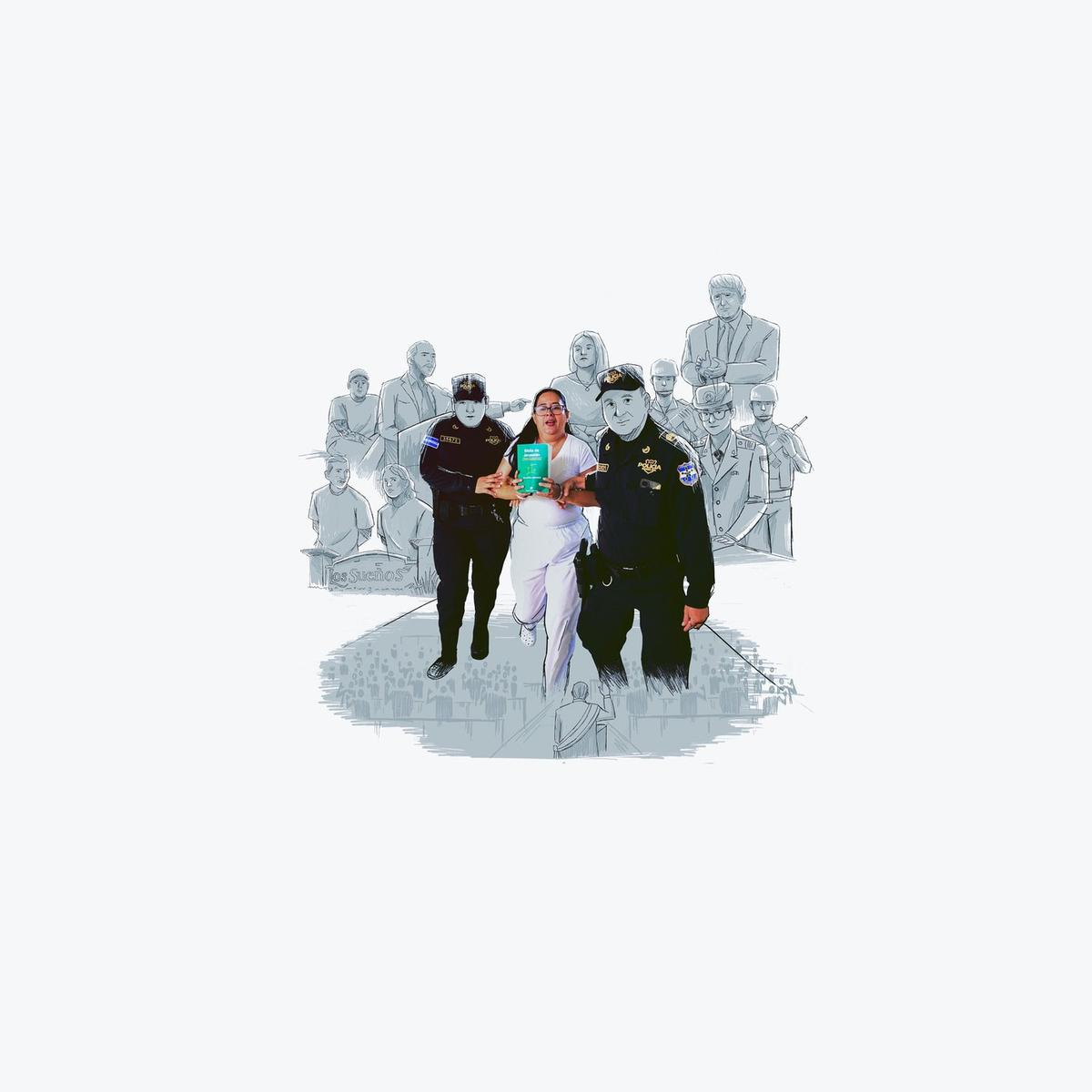
Her husband said that police officers tried to blackmail Ruth on the day of her first hearing, June 4, when she was remanded in custody for six months. That morning, the police told both of them that they could meet and have lunch together if she agreed to change her clothes before the hearing: to take off the white garments characteristic of prisoners in the Bukele era and replace them with casual clothes. Ruth refused. She assumed it was a ploy to make her appear more comfortable than she was. So, even under those conditions, Ruth did what she always did: She spoke out. During the few seconds that the cameras managed to film her, before she entered the courthouse, as the police officers carried her in, Ruth shouted her accusations and left the nation with one of the harshest scenes of repression and also of dignity: “They didn’t bring me because I didn’t change my clothes. They wanted me to come in a suit!” she said, handcuffed at the wrists. She was carrying the Jerusalem Bible in her hands, one of the books that Louis, her husband, had been able to bring her in her first days of captivity.
After the hearing, when she had already been sentenced to six months of provisional imprisonment, she continued her denunciation in the only way she could, shouting:
“They won’t silence me! I want a public trial! I want them to grant me a public trial! He who owes nothing fears nothing! I am innocent! I am a political prisoner! All the charges are because of my legal work, because of my denunciation of corruption in this government! There is no public institution that guarantees rights! I am innocent and I will prove my innocence! I want a public trial! They want to accuse me for not keeping quiet about corruption!”
In early July, the head of the jail said there was no more room for Ruth and ordered her transfer to a prison. Louis saw her for the last time on Thursday, July 3. On the 4th, he tried to visit her at the Police Traffic Station at 8 a.m., but was told that a prosecution was underway, making the visit impossible. At 10 a.m., someone told him that Ruth was no longer there, that she had been transferred to Izalco. “They took her away without telling me, while I was there,” says Louis. With a brother-in-law, he drove to the Izalco Penitentiary Farm, where two guards referred to her as “the famous one” and told Louis that he would never be able to visit her. On July 28, a prison employee told one of Ruth’s lawyers that all visits were prohibited while “the president of the Republic is in office.” Like so many relatives of detainees during the state of exception, Louis has only been able to leave her medicine and food with the guards in the hope that she will receive them.

Abraham Ábrego, Ruth’s colleague at Cristosal, has been in charge of much of the legal strategy that allowed her to receive medicine and spend a month in the Transit Division. Ábrego sums up in a few words what he has felt all this time. It’s a feeling of frustration, he says, like when you have to deal with a kidnapper:
“It’s like walking a tightrope because if you complain too much, it can lead to revenge or something else. It’s very subjective because I think all the officials in the Bukele clan play a lot with irregularities, with feelings, with revenge, so the relationship is very volatile. In Cristosal’s case, I think there is still a rejection of us, so in Ruth’s case, we have tried to keep a low profile because we are also concerned about the safety of the legal team there in El Salvador.”
Total Secrecy
The embezzlement charge against Ruth —which involved her supposedly handling of public funds, something she had never done— was so empty that prosecutors had to replace it two weeks later with illicit enrichment. By changing the crime, the state further revealed its arbitrariness. Any criminal accusation of this nature requires that illicit enrichment has been previously proven in a financial review and then in a civil trial. In Ruth’s case, neither a financial review nor a civil investigation exists.
On July 21, when Ruth had already been in prison for two months, the Supreme Court “integrity” office auditing the work of public officials, known as Probidad, assured that it was investigating Ruth’s finances. It sent an email to a family member requesting information about her accounts for 2016, when she was an advisor to the general directorate of Social Security and a member of the board of directors of the Superintendency of the Financial System. Ruth’s family suspects that the Attorney General’s Office may be trying to justify gaps in the evidence in its indictment.
It is impossible to know dates, amounts, and other details because the Fourth Court of Instruction of San Salvador has decreed “total secrecy” for the case, an increasingly common label in the judicial system controlled by Bukele. That is why Ruth demanded a public trial. “The people deserve to know,” she shouted outside the courthouse.
On the night of her arrest, the Attorney General’s Office said on social media that the indictment was based on her working relationship with Eugenio Chicas, describing her as his “right hand.” The truth is that they did cultivate a deep friendship, which continued even when, in July 2014, Ruth became legal advisor to the Salvadoran Social Security Institute. In 2015, Eugenio was appointed Secretary of Communications for the Presidency. Now prosecutors are investigating both of them in secret proceedings.
Chicas is also a political prisoner: He was arrested in February 2025 after more than two years of being investigated for alleged illicit enrichment, a crime that, to date, has not been proven. The Court opened his case in late 2022, a year after Bukele took control of the Constitutional Chamber and the Judiciary. Prosecutors indicted him in January 2023, and he was convicted in November 2024, but Chicas appealed. The Civil Chamber of the Supreme Court is still investigating whether he enriched himself with public funds, but in early February 2025, the Attorney General’s Office decided that it could bring criminal charges against him for that enrichment and also ordered his arrest. His trial, like Ruth’s and that of more than 87,000 people arrested under the state of exception since March 2022, is secret. The arbitrariness of the proceedings against Chicas appears to be retaliation against a man who defeated Bukele in court in a defamation case in 2019. Chicas also made the regime uncomfortable with his opinion columns and his activism against the implementation of Bitcoin as legal tender. He called Bukele a “coward” and a “loose mouth.”
On the same day that Ruth was arrested for illicit enrichment, Chicas was charged with a new crime: embezzlement. Prosecutors now say that Chicas, too, appropriated state funds that he administered while working in the FMLN governments. In the two years prior to his civil case, the Attorney General’s Office showed no indication of this, much less that Ruth had anything to do with this accusation, since she had no authority to sign off on public spending.
As with other activists and journalists, the smear of Ruth by those in power did not begin prior to her arrest; it has been building for years. In September 2021, Diario El Salvador, the dictatorship’s propaganda organ financed with public money, published an article entitled: “Ruth López and her husband received more than $11,000 in just three years in travel expenses from the TSE.” During those years, between 2011 and 2014, a right-wing politician named Walter Araujo also worked as a magistrate at the TSE. Probidad found that he collected $58,000 in travel allowances for trips abroad between 2004 and 2014 that he never took, according to the Immigration Directorate. But Diario El Salvador has said nothing about this. Araujo is a YouTuber who, from his program, praises Bukele and Nuevas Ideas and insults all critics of the government. Ruth was one of the most insulted figures in his broadcasts.

The IACHR issued precautionary measures to protect Ruth on September 22, four months after her arrest. The Commission ordered that Ruth’s detention comply with international standards, that she be allowed to communicate with her lawyers and family, and that measures be taken to guarantee her rights. But the Salvadoran state requested that its response to these orders be kept completely secret. Whether the state has already taken any measures in this regard is unknown because El Salvador requested it. The dictatorship’s decision is that everything related to Ruth’s case should be kept under lock and key.
In theory, the court’s investigation period in Ruth’s case ended on December 4. She must attend a second hearing at which it may be decided whether she will be released on parole. At the time of writing, those close to Ruth have little or no expectation that this will happen. The Attorney General’s Office may request an extension of the investigation phase and, with that, keep Ruth in detention.
When Louis hears the idea that the dictatorship has launched its most severe threat to its critics through Ruth’s imprisonment, he responds: “We must organize ourselves. If we don’t get involved in rebuilding, we might as well leave, because the country would be doomed to collapse. We may be afraid, but even so, we can do things without making such a fuss.”