
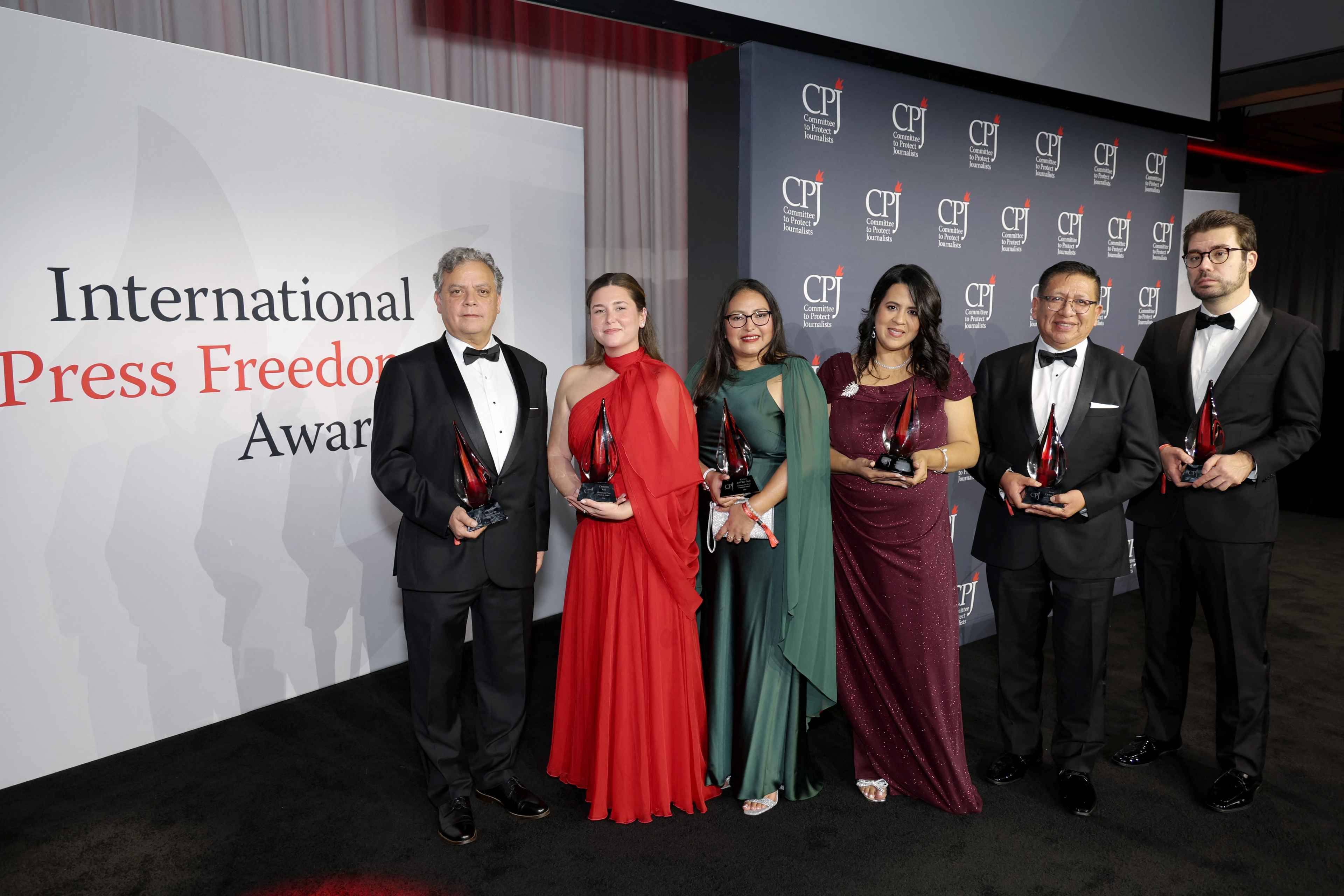
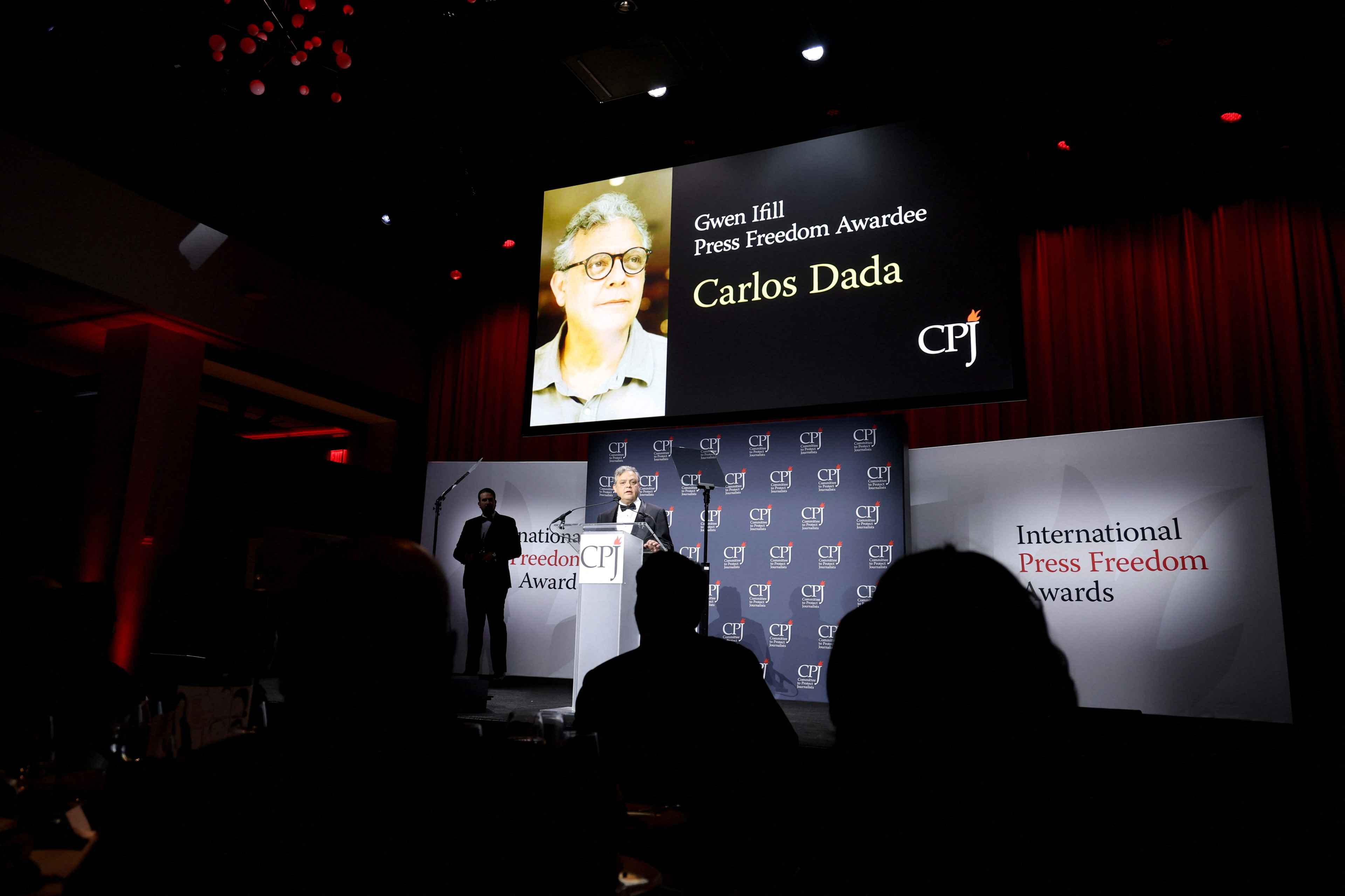
This is a transcript of editor-in-chief Carlos Dada’s acceptance speech upon receiving the CPJ Gwen Ifill Press Freedom Award on Thursday, November 19.
I’m humbled to share this stage with my colleagues awarded tonight with the IPFAwards. I’m inspired by your commitment to tell the truth under such enduring circumstances. I can’t say congratulations, because this is the kind of award we would rather not receive, if we could just do our jobs without having to go through what you have gone through.
Thank you, CPJ, for your work. You have been, for us, a constant companion in hard times. I learned about CPJ almost three decades ago. We had just launched El Faro. During a short residence in the city, a much younger me visited a much younger Joel Simon. I left his office with a copy of his recently published book, Endangered Mexico. I found your work very helpful to understand the situation of journalism around the world. From those years’ reports, it looked grim. The nineties look now like the golden years of journalism.
Carlos Dada to Receive Gwen Ifill Press Freedom Award
Shortly after that, we started receiving threats in San Salvador. From drug cartels, from police squads, from war criminals, from gangs. The calls and meetings with Carlos Lauría were so frequent that we became good friends. Now, when the threats come from the State, the calls and meetings come from Carlos Martinez de la Serna, a brave defender of journalism.
I’m thankful to the board for distinguishing me with the Gwen Ifill award. I was very touched to receive the news from Jose Carlos Zamora, who knows first hand the price to pay when a brave journalist is determined to tell truth to a corrupt power. A price not only paid by his father, Jose Rubén Zamora, who is an inspiration to me and was imprisoned for years. The family also takes a toll.
So here is to my own: Thank you, Janieke, for patiently enduring my frustrations and my nostalgia of the recent years with care and love. Together we are raising a living hope for a better future. To my parents and siblings, who have always been there behind me, repairing some of the things I break. And of course my team. I work with people whose commitment to journalism and the search of truth has but been reaffirmed under the most demanding circumstances. I’m very proud of working with them.


This award comes at a critical moment for us, when, as many newsrooms around the world, we face existential challenges. I will come back to this. But first allow me to tell you a story.
A few decades ago, El Salvador was living under a military regime. The Catholic Church had a small radio station, which broadcasted the homilies of Archbishop Óscar Romero. Those sermons were the most accurate reports on human rights violations. From the pulpit, Romero would denounce death squad operations, forced disappearances, torture, killings, the longsuffering of the poor. The radio was a constant target of violent attacks that would put it off for a few days.
After yet another attack, Romero said: “If they control all the media, why are they worried about a small radio transmitter? Justice is our strength, the truth is what makes the smallness of our media great. That is why they fear it.” Romero was killed in 1980. But I make those words mine, for all our colleagues under attack for informing the public. Truth is what makes our smallness great.
Journalism as Resistance
At this turn of history, journalism is living some of its darkest passages. My Central American colleagues are being harassed, imprisoned, killed, or exiled for investigating corrupt public officials who have amassed too much power. I’m also thinking of my colleagues from Venezuela, Cuba, and Nicaragua, who guide us on doing journalism from exile.
I think of my Mexican colleagues, who persist in shedding light on the bottomless pit of organized crime violence, at the risk of ending up murdered.
I think of my colleagues, our colleagues, in Gaza, trying to keep their heads up while drones roam above them. 86 killed in 2025. Many of them, according to CPJ, deliberately targeted by Israel, the same State that impedes the presence of international reporters. Everytime I hear Jody Ginsberg so soundly denounce the crimes against our Palestinian colleagues, that I can only describe as a journocide, I wonder what am I doing for them, killed for doing the same that I do, but at an immensely higher risk. We are not doing enough to protect them, to hold their killers accountable.
But the situation is bad elsewhere. Hundreds of journalists imprisoned. Records of reporters, editors, and media in exile. The last two years are the worst on record for attacks against the press. It is no coincidence that we are also living through democracy’s deepest crisis since the end of the Cold War. As the list of democracies in the world shrinks, the number of exiled, imprisoned, and killed journalists increases.
Even here. Journalists used to go abroad to report on authoritarian regimes, on abuses of power, on attacks against civil society. In recent years, you have reported on these topics in your own country, and are more aware of the risks of losing press freedom.
But you have seen, recently, the consequences of your work, of providing citizens with useful information to make crucial decisions for this country. That is how important journalism is.
On the other side of the world, in Moscow, the recent closure of Novaya Gazeta should be a constant reminder of how much is lost when an excellent, determined, and independent journalistic institution ceases to operate. Their closure is a tragedy for all of us.
El Faro is fully operating from exile, after years of threats, lawfare, surveillance, smear campaigns, economic asphyxia, and false accusations. It has made our job much more difficult but they have not managed to silence us. We keep producing relevant investigations on corruption, human rights violations, abuses of power.
To thrive, journalism requires rule of law, and democracy requires journalism. Absent those two elements, journalism requires external life support if it is not willing to capitulate. Political coverage, legal and financial support, a safe haven.
We have reluctantly become part of the story. Attacks against the press also reveal the nature of the attackers. Most Salvadoran independent journalists are now in exile. Some ceased practicing. We have lost their contributions.
But the real question is why we are in exile. What is the truth that the regime needs to conceal?
El Salvador’s president, Nayib Bukele, is the reference for a new wave of authoritarian populists that embrace his model as an effective means to combat organized crime. At the basis of his reputation is the fact that he managed to take violent gangs off the streets.
CECOT, the megaprison known around the world, has become the postcard of the so-called Bukele model and an effective political vehicle throughout Latin America, a region maimed by organized crime. But behind the postcard lies a murky deal between Bukele and the gang leaders, protected by another shady deal between Bukele and President Trump.
As we speak, El Salvador is living through its fifth year under a state of emergency that severely limits some fundamental rights, like the presumption of innocence and the right to defend yourself. The real Bukele model is one of concentration of power, lack of accountability and restriction of citizens rights. Of impunity. El Salvador now is a police state. A dictatorship. And in a dictatorship there is no rule of law.
It’s the story of one hundred thousand detentions in five years, most of them innocent people captured by police agents to fulfill daily quotas. The truth, that journalism and human rights organizations have dutifully established, is the return of systematic torture. The disappearance of thousands inside the prisons. The truth is the pledge of their mothers and relatives, to know if they are still alive. The truth is that hundreds have been killed under torture, buried in mass graves without notifying the families. We have identified the torturers, groups of prison guards that still operate.
Among the detained: handicapped children, dissidents, political rivals, human rights defenders, environmentalists.
In Bukele’s El Salvador, people are afraid to talk. The alternative to silence is exile, prison or else.
There is one aspect of exile that generally goes unnoticed: the risk of being killed or imprisoned decreases significantly. Not entirely, but significantly. Therefore, we can talk. We are free to tell the truth about a regime that sustains itself on lies. To raise our voices while those inside the country remain silent.
We need to bring back to the public debate the unique contributions of journalism to democracy, to freer societies, to accountability, to justice. Truth is what makes our smallness great. But we need support to keep telling it.