El Faro English translates Central America. Get our reporting in your inbox.
In the past five years, El Salvador’s opposition parties have lost almost all political representation in national and local offices, defeated by President Nayib Bukele’s popularity and suffocated by official hostility and curbed financing. But for some, internal strife has seemed almost as intense as the external.
So much so that legislator Claudia Ortiz, one of the most visible opposition figures in El Salvador, says she is facing not only “the dictatorship” but also differences “in vision” with the leaders of her centrist minority party, Vamos.
In 2024, Ortiz was the opposition candidate for the Legislative Assembly who received the most votes in San Salvador, surpassing parties that had dominated national politics for decades, like the rightist ARENA and leftist FMLN. But 57 of 60 seats are held by the ruling party Nuevas Ideas and allies.
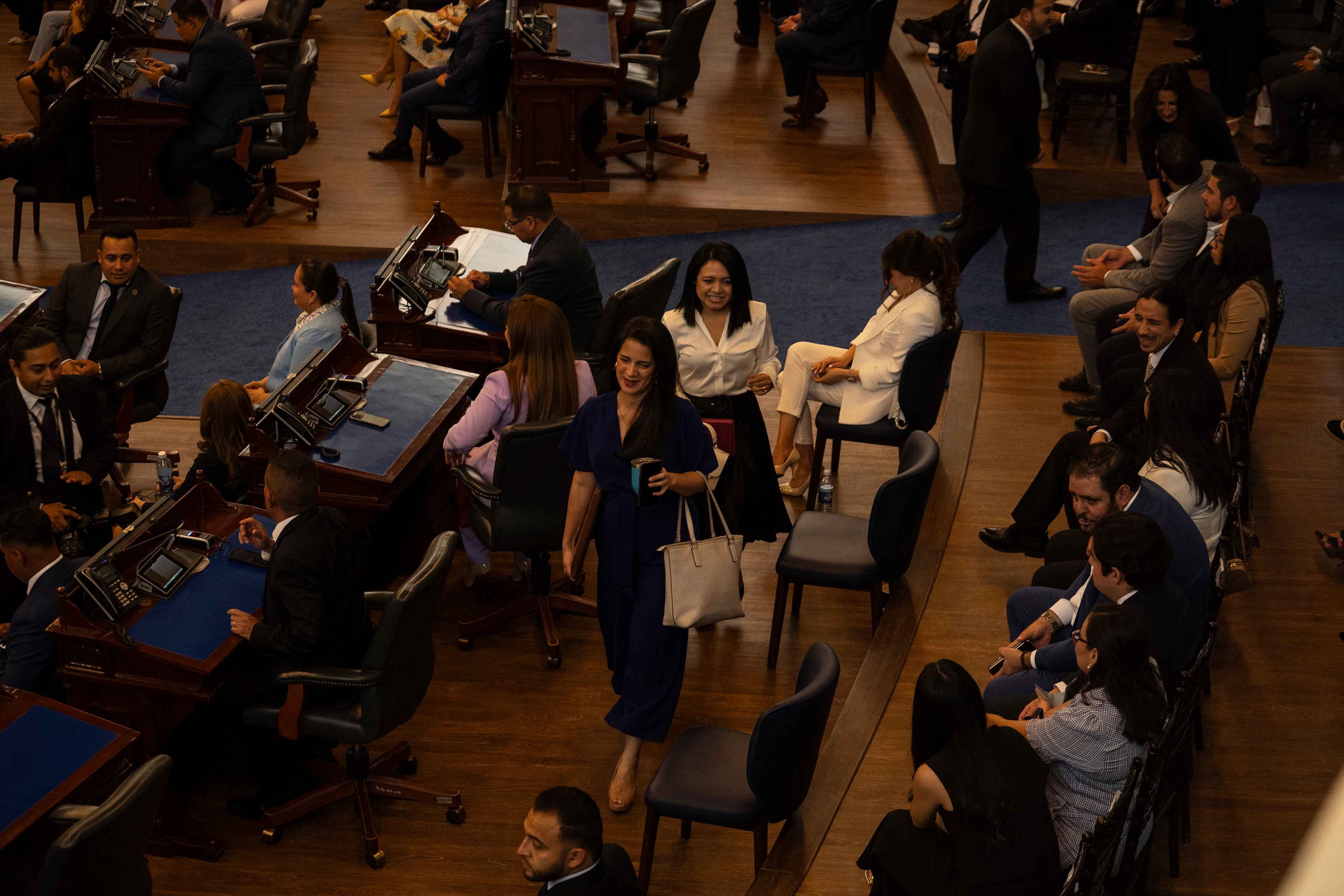
Ortiz is the party’s only sitting assemblywoman, known more for her opposition to Bukele than for any other policy.



El Salvador will hold national elections on February 28, 2027. El Faro interviewed Ortiz and the party’s secretary-general, Cesia Rivas, who is also, uncomfortably, Ortiz’s alternate in the Assembly. Their visions were visibly at odds, especially over the broader strategy needed to mount any substantive resistance to Bukele after the elections.
Ortiz asserts that she and other party members see the need for the party to form alliances with diverse sectors and ideologies. In contrast, the rest of Vamos decided in November not to form party coalitions, nor to accept former members of other political groups into their ranks.
Civil Society Leads Push for Unified Opposition Candidate in El Salvador
In the year leading up to the 2024 elections, civil society groups led a push to get El Salvador’s opposition parties of diverse stripes onto the same presidential ticket. But the negotiations fell apart. ARENA and the FMLN both ran their own candidates, while Vamos and a similar minority party, Nuestro Tiempo, ran a joint presidential ticket.
The opposition parties’ jockeying played out amid debate over whether competing in the elections legitimized Bukele’s unconstitutional bid for a second term. Ultimately, Bukele swept a contest marked by irregularities, reducing the political opposition to historic lows.
A “large, open, democratic” party
In these elections, according to Ortiz, the party should make inroads with social, political, and even economic sectors, but she says the Vamos leadership has a different vision “of keeping the party closed, small, and controllable.”
In 2023, Bukele pushed through reforms aimed, among other things, at reducing the number of legislators. In El Salvador, where public opinion polls have long shown low approval for the legislature, Vamos is one of four minority parties that snagged a seat in this Assembly. The PCN and the PDC vote in line with Bukele, while ARENA and Vamos typically vote against.
Vamos is the third-most-preferred party for the 2027 legislative elections after Nuevas Ideas and Arena, according to a June poll by Central American University. More broadly, Vamos slipped to fourth most popular behind the FMLN.
But in a country where nearly nine out of ten Salvadorans support Bukele, more than 60 percent said they had no party preference. His party ranks first by far, but with only 34.2 percent of polling preference.
“We need a party that is large, strong, open, and democratic,” Ortiz said. Rivas said it isn’t true that the party is not seeking alliances. She asserted that Ortiz only received authorization from the party’s National Assembly to negotiate alliances with “civil society.”
“It was never decided that we would accept people from other parties,” Rivas said. She cited Ortiz’s outreach to the Salvadoran Leftist Movement (MIS), founded in 2022 and led by writer Walter Raudales, who proposed that Arena, the FMLN, and Vamos must unite in the elections.
Ortiz countered that the MIS does not represent the FMLN. “Just because there may be people in the MIS who at some point were active members, sympathizers, or shared the ideology doesn’t automatically mean they’re the same,” she said.
El Faro also spoke with Raudales. He said that when the MIS proposed that opposition parties unite to build an electoral alternative to Bukele last year, only Ortiz “sat down, and listened to us.” Ortiz indicated that talks with the MIS are ongoing, as are discussions with other groups.
Vamos will now compete in the legislative elections nationwide, unlike in 2024 when they fielded candidates in only five of 14 departments. “90 percent of the candidates didn’t previously belong to Vamos. If that isn’t opening up the party, I don’t know what is,” Rivas said.
Suspicions of a break
Ortiz said that when she tried to get more people to join the party, “we found there was a selection process where we didn’t know the criteria.” Party leadership reported that 30 of some 150 candidates were rejected, including due to priors in ARENA, FMLN, or Nuevas Ideas.
In early July, Ortiz also announced on social media that the remote digital voting system was unreliable. The Permanent Electoral Commission, the Vamos authority in charge of internal voting, rebuffed the allegations. But on July 12, the voting system malfunctioned.
TSE President Admitted Irregularities and “Possible Intervention” in Salvadoran Election
When the term of the current leadership ends in September, she wants to replace Rivas as secretary-general in order to “get the house in order.” In July, Ortiz posted a letter signed by a dozen Vamos members calling for internal elections to choose new leadership.
The secretary-general believes that airing differences on social media is damaging Vamos’s image. “Every step should have been taken to resolve conflicts internally,” she said.
Ortiz isn’t shy about her desire to run for president. She told El Faro that she still plans to do so, but “in the medium or long term.” “The conditions don’t exist. No other party is on the same level as the president,” she said. “National leadership needs to be developed over time.”

Within Vamos, Ortiz’s moves are being viewed with suspicion. One party leader claimed she might decide to leave the party altogether. Ortiz “internally informed the party of the existence of a movement called ‘Avanza’ or ‘Avancemos,’” meaning to ‘move forward,’ said the source, who commented on condition of anonymity.
Ortiz denied having any plans to leave, and said Avancemos is “a philosophy of doing politics, not a movement.” But it just may become a formal group. “We’d need to talk to more people who share that vision,” she said.
On social media, she has shared excerpts from an interview in which she uses the verb avanzar repeatedly. The verb itself seems to point to the opposition’s dilemma. In August 2025, the Assembly approved a process to amend the constitution without due process.
Ortiz had originally planned to run for president in 2029, until Bukele moved the elections forward and extended the next term from 2027 to 2033. “We’ll have to plan for who knows when,” she said. “Now the rules are that the rules can be changed at any time.”
This article appeared in the El Faro English newsletter. Subscribe here for more journalism translating Central America.